
Pickleball Kitchen Rules Explained: The Easy 2026 Guide
Pickleball kitchen rules cause more confusion, and more arguments, than almost any other part of the game. New players hear “you can’t volley in the kitchen” and assume that covers it, then get called for a fault they did not see coming because the actual rule involves footwork, momentum, and timing in ways that are not obvious from a single sentence.
If you have not covered the broader rulebook yet, our complete pickleball rules guide is a good starting point before diving into this one specific, heavily misunderstood zone. This guide breaks down exactly what the kitchen is, when you can and cannot enter it, and the common faults that trip up even players who think they already understand the rule.
What Is the Kitchen in Pickleball?
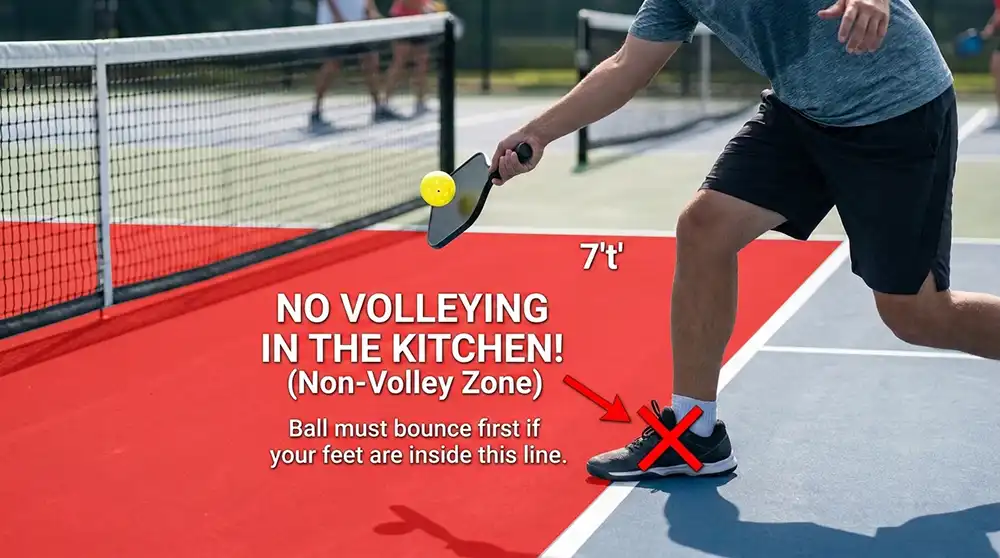
Understanding pickleball kitchen rules starts with the zone itself. The kitchen, officially called the non-volley zone or NVZ, is the seven-foot area on each side of the net, measured from the net back toward the baseline. It spans the full width of the court on both sides. Despite the informal nickname, there is nothing about cooking involved, the term is generally believed to come from shuffleboard, where a similar restricted zone near the front carries the same name.
Every pickleball court has this zone marked with a line, and that line itself is considered part of the kitchen. Stepping on the line counts as being in the kitchen, not outside it, a detail that catches new players off guard constantly.
The Non-Volley Zone Rule Explained
The core of all pickleball kitchen rules is simple to state and harder to apply under pressure: you cannot volley the ball, hit it out of the air before it bounces, while any part of your body is touching the kitchen or the kitchen line.
You absolutely can stand in the kitchen and hit the ball, as long as the ball has bounced first. Groundstrokes from inside the kitchen are completely legal. The restriction is specifically about volleying while positioned in that zone, not about being in the zone at all.
Momentum makes this trickier than it sounds. If you volley a ball while standing outside the kitchen, but your momentum carries you into the kitchen immediately afterward, that is a fault. The rule accounts for follow-through, not just your position at contact.
Common Kitchen Faults (With Examples)
Most violations of pickleball kitchen rules fall into a handful of predictable patterns:
The step-in volley. A player volleys the ball while their back foot is still in the kitchen from a previous shot. Even one foot touching the line while volleying is a fault.
The momentum carry. A player volleys a hard-hit ball while standing just outside the kitchen, but the force of the swing carries them stepping into the zone immediately after contact. This counts as a fault even though the volley itself happened outside the line.
The paddle touch. Less common but still a fault: touching the kitchen or the kitchen line with your paddle, clothing, or anything else you are carrying while volleying, even if your feet never cross the line.
The premature entry. Moving into the kitchen before the ball has bounced on your side, then hitting it as a groundstroke after it bounces, is actually legal. The confusion here usually comes from players assuming any kitchen entry during a rally is illegal, which is not true as long as no volley occurs while inside.
Can You Enter the Kitchen? When It's Allowed
A common misconception in pickleball kitchen rules is that entering the zone itself is illegal. Yes, entering the kitchen is allowed at almost any point during a rally. The restriction is entirely about volleying, not about standing in the zone. Players regularly step into the kitchen to hit a bounced ball, then step back out before the next volley opportunity arises.
This is exactly why dinking, the soft, controlled shot exchange near the net, works the way it does. Players often stand right at or near the kitchen line, letting the ball bounce before contact, without ever technically violating the rule, since no volley occurs while they are positioned inside the zone.
The only real restriction is timing: you must fully exit the kitchen, feet clear of the zone and the line, before you are legally allowed to volley again.
Kitchen Rules for Doubles Play
The pickleball kitchen rules apply identically in doubles, but doubles play creates more opportunities for violations simply because there are more players and more court awareness required.
Partner positioning. Both players on a team need to track their own foot position independently. It is common for one partner to correctly stay clear of the kitchen while the other, focused on the ball, drifts a foot onto the line without realizing it.
Crossing over. When a partner poaches or crosses over to cover a shot, they carry the same kitchen restriction with them. A player who crosses into their partner’s side while still needing to volley must respect the kitchen line just as they would on their own side.
Communication reduces faults. Calling out “back” or “kitchen” to a partner who is drifting into the zone during a fast exchange is common practice among competitive doubles teams specifically to avoid unnecessary faults during high-pressure rallies.
Why the Kitchen Rule Exists
Without pickleball kitchen rules restricting play near the net, the sport would likely turn into a power-dominated game similar to volleyball at the net, where taller or more athletic players could simply crowd the net and slam every ball out of the air. The kitchen rule forces play to slow down near the net, rewarding placement, patience, and touch over raw power.
This is a big part of why pickleball remains accessible across a wide range of ages and athletic abilities in a way that few other competitive racquet sports manage. The soft game the kitchen rule creates levels the playing field between a powerful 25-year-old and a strategic 65-year-old in a way a pure power game never could.
Practicing Kitchen Awareness
Faults under pickleball kitchen rules are rarely about not knowing the rule, they are almost always about footwork awareness breaking down during fast exchanges. Our pickleball drills guide covers dinking-specific drills that build the footwork discipline needed to stay aware of the line even during quick, competitive rallies.
A simple self-check drill: place a towel or line marker exactly on your side’s kitchen line and practice dinking rallies while consciously checking your foot position after every shot. Most players are surprised how often they drift closer to the line than they realized once they start paying attention.
How Pickleball Kitchen Rules Have Changed Over Time
Pickleball kitchen rules have stayed relatively stable compared to other parts of the rulebook, but officiating and enforcement have tightened noticeably as competitive play has grown. Early recreational play often let ambiguous foot-fault calls slide in casual games, since most matches were self-officiated among friends.
As tournament play expanded and paid officials became more common, the momentum-carry rule specifically received far more consistent enforcement. What used to be a borderline judgment call in casual games is now a clearly defined fault at any officiated level, which is part of why understanding the full nuance of pickleball kitchen rules matters more now than it did in the sport’s earlier, more casual years.
The core seven-foot distance and the no-volley principle itself have not changed meaningfully since the sport’s early rulebooks, the real evolution has been in how consistently and precisely the rule gets called.
Frequently Asked Questions
Common questions players ask about pickleball kitchen rules.
How far is the kitchen from the net?
The non-volley zone extends 7 feet from the net on each side, spanning the full width of the court, for a total non-volley zone depth of 14 feet across both sides combined.
Is stepping on the kitchen line a fault?
Only if you are volleying while touching the line. The line itself counts as part of the kitchen, so any part of your body touching it during a volley is a fault, but simply standing on the line without volleying is not.
Can you serve from inside the kitchen?
No. The serve must be hit from behind the baseline, well outside the kitchen, and the server’s feet cannot touch the baseline or inside the court until after contact.
What happens if you fault in the kitchen?
A kitchen fault immediately ends the rally, awarding the point (if returning serve) or the serve (if serving) to the opposing side, exactly like any other rule violation.
Can your paddle enter the kitchen without a fault?
Only if you are not volleying at the time. If your paddle touches the kitchen or its line while making contact with the ball in the air, that is a fault regardless of where your feet are.
Do professional players violate kitchen rules often?
Rarely intentionally, but momentum-carry faults do happen even at high levels during fast, aggressive exchanges, which shows how much footwork discipline the rule genuinely demands.
Do pickleball kitchen rules differ between singles and doubles?
No. The non-volley zone dimensions and the volley restriction apply identically regardless of format, though doubles play tends to produce more accidental faults simply due to two players moving and communicating near the line at once.
Can a ball bounce inside the kitchen and still be in play?
Yes. A ball that bounces inside the non-volley zone is completely legal to return, as long as you let it bounce before hitting it. Only volleying while positioned in the zone is restricted, not the ball landing there.
Pickleball kitchen rules feel complicated at first mostly because the informal explanation, “no volleys in the kitchen”, leaves out the momentum, timing, and doubles-specific nuances that actually decide close calls during real matches. Once the footwork becomes automatic, most players stop thinking about the rule consciously altogether, and it simply becomes part of how they move near the net.
The fastest way to internalize it is repetition near the line itself. Reading about the rule only gets you partway there, dedicated practice time at the kitchen line is what actually makes the awareness stick.
