
Pickleball Court Dimensions: Official Size & Layout Guide
Understanding the official pickleball court dimensions is the first step before you pick up a paddle, set up a net, or convert an existing court.
Let’s be honest: staring at a mess of court lines can be confusing. If you are converting a tennis court, taping up a driveway, or just trying to figure out if that ball was actually “out,” you need the right numbers. Getting the pickleball court dimensions right is crucial because even a few inches can change the entire flow of the game.
Whether you are a total beginner looking to understand the boundaries or a DIY-er ready to lay down some tape, here is everything you need to know about official pickleball court dimensions.
If you just need the raw data to start measuring, here is the cheat sheet. These are the official specifications according to USA Pickleball.
| Measurement | Official Dimension |
|---|---|
| Court Length | 44 feet (inclusive of lines) |
| Court Width | 20 feet (inclusive of lines) |
| Net Height (Sidelines) | 36 inches |
| Net Height (Center) | 34 inches |
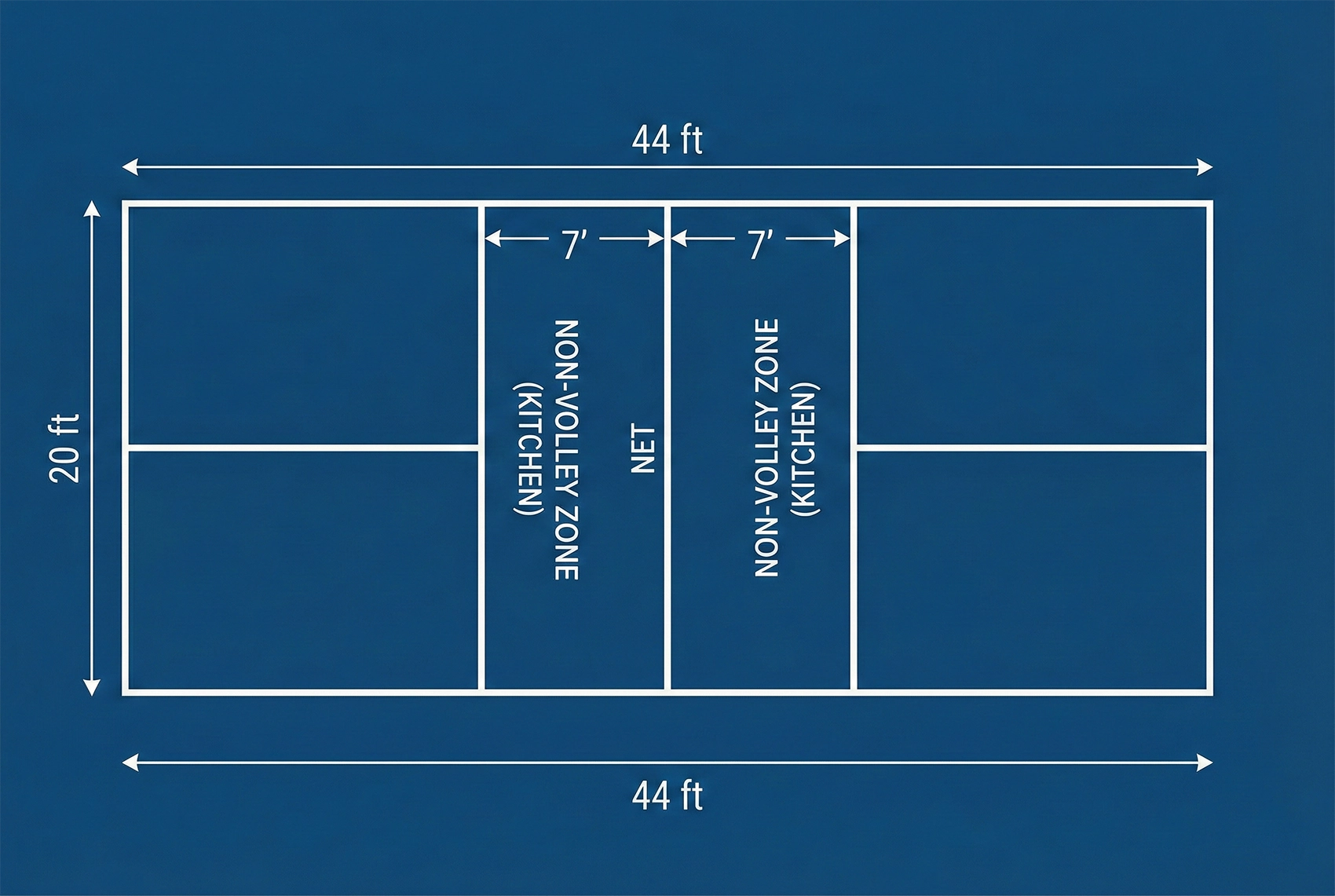
| Non-Volley Zone (Kitchen) | 7 feet each side |
| Line Width | 2 inches |
The Official Pickleball Court Dimensions Explained
The first thing you need to realize is that a pickleball court is relatively small. It is identical to the dimensions of a doubles badminton court. The total playing area measures 20 feet wide by 44 feet long.
Here is the golden rule that trips up a lot of tennis converts: in pickleball, Singles and Doubles are played on the exact same court size.
In tennis, you have those “alleys” on the sides that are safe for doubles but “out” for singles. In pickleball? Those alleys don’t exist. The court is 20 feet wide, regardless of how many people are playing. That makes your life a lot easier when setting up.
[Read our full Singles vs Doubles Guide]
Pickleball Court Dimensions Breakdown
| Measurement Type | Official Dimension |
|---|---|
| Total Length | 44 feet |
| Total Width | 20 feet |
| Kitchen Depth | 7 feet |
| Service Area Depth | 15 feet |
| Service Area Width | 10 feet |
| Baseline to Net | 22 feet |
Anatomy of the Court — Understanding the Lines
Knowing the pickleball court dimensions is one thing, but knowing why the lines are there will actually help you win more points. Let’s break down the anatomy of the court.
Baselines
These are the back lines of the court, running parallel to the net. They are exactly 22 feet from the net. When you serve, you must stay behind this line. If you are playing deep, this is your home base.
Sidelines
These are the boundary lines running perpendicular to the net, defining the 20-foot width. If a ball lands on the line, it is considered “in.”
The Non-Volley Zone (The Kitchen)
This is the most famous part of the court. The Non-Volley Zone extends 7 feet from the net on both sides. The Kitchen line runs parallel to the net. It’s vital to measure this correctly because this 7-foot buffer is what prevents players from smashing the ball right at the net. Remember, the line itself is part of the Kitchen — if your toe touches that line while volleying, it’s a fault.
[Kitchen Rules Explained — Full Guide]
Centerline
This line extends from the Kitchen line back to the baseline, splitting the backcourt into two service courts (the Right/Even court and the Left/Odd court). Each service court box measures 10 feet wide by 15 feet deep.
Line Width
Official rules state that lines should be 2 inches wide. When measuring your 20 feet by 44 feet, the measurement is taken to the outside of the lines.
Net Height Requirements
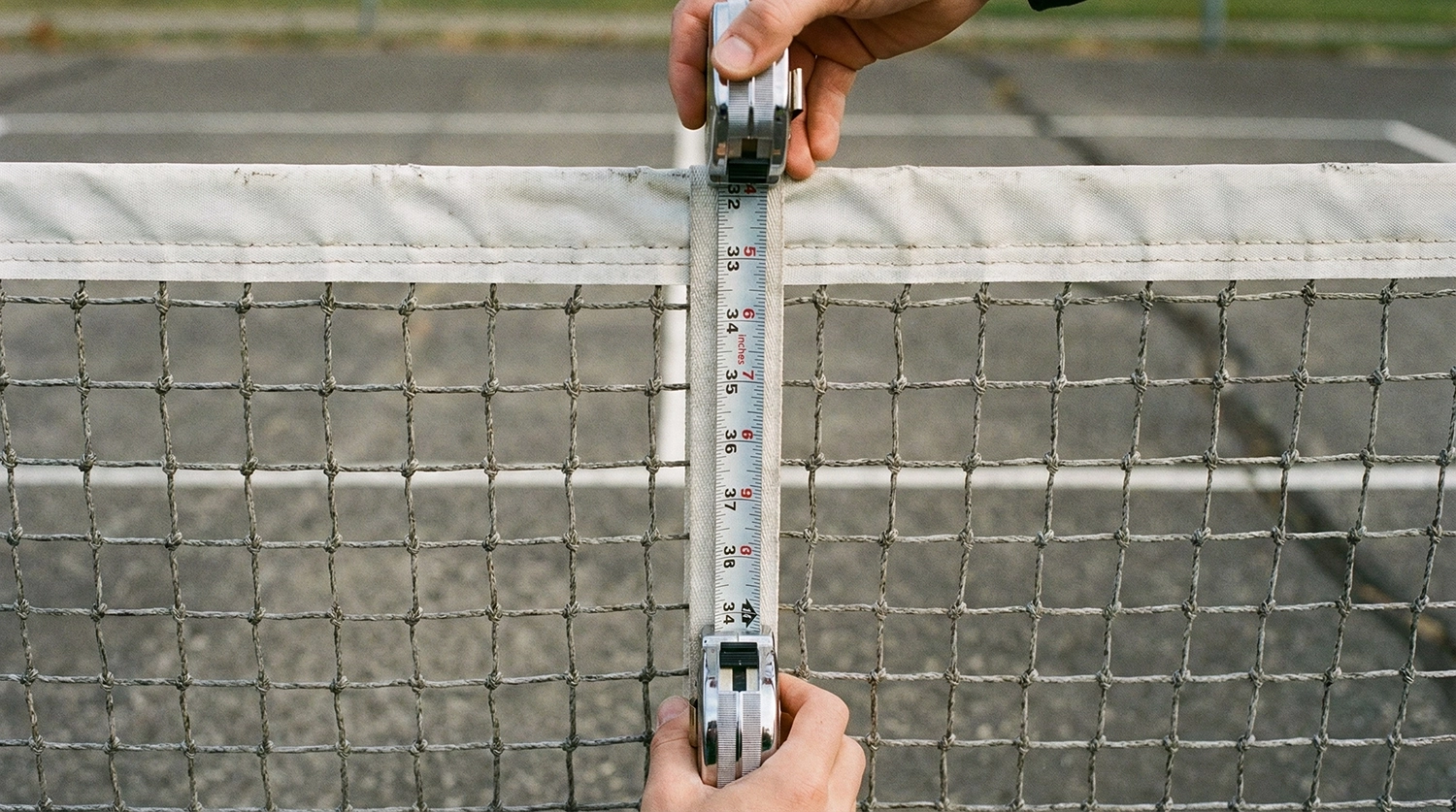
If you are coming from tennis, the net might look a little saggy to you. That is intentional. A pickleball net is not a straight line across the top — it hangs lower in the middle to allow for more rallies and strategic play.
- Sideline Height: 36 inches high where it crosses the sidelines.
- Center Height: 34 inches at the exact center of the court.
Most permanent nets use a center strap to hold it down to that 34-inch mark. If you are using a portable net, make sure the tension isn’t too tight — you want that distinct curve.
Total Playing Area — Safety Margins
Here is a mistake people make all the time: they measure out a 20-foot by 44-foot rectangle in their backyard, paint the lines, and then realize they have zero room to run. You need “overrun” space for safety and playability.
- Minimum Recommended Size: 30 feet wide by 60 feet long — 5 feet of safety on the sides and 8 feet behind the baselines.
- Preferred Size: 34 feet wide by 64 feet long — standard for tournament play.
Indoor vs. Outdoor Differences
The actual pickleball court dimensions — 20 x 44 feet — never change, whether you are playing on concrete under the sun or on a gym floor. However, the feel is different.
Outdoor courts are usually concrete or asphalt with an acrylic coating. Indoor courts are often wood or synthetic gym floors. The ball skips faster on gym floors. If you are taping lines on a gym floor for temporary play, use painter’s tape or specific court tape that won’t damage the finish.
How to Convert a Tennis Court to Pickleball
Converting an existing tennis court is the fastest and most cost-effective way to get a permanent pickleball court. Here’s exactly how to do it.
Step 1: Lower the net. A tennis net sits at 36 inches at the center pickleball needs 34 inches. Use a center strap to pull the net down to the correct height. Most tennis nets already have a center strap. Simply tighten it until the center reads 34 inches.
Step 2: Mark the pickleball court dimensions. Using temporary chalk or permanent paint, mark out your 20 x 44-foot rectangle inside the tennis court. Center it on the tennis net. A standard tennis court (60 x 120 feet) fits 4 pickleball courts comfortably 2 on each side of the net.
Step 3: Mark the Kitchen line. Measure exactly 7 feet from each side of the net and mark the Non-Volley Zone line parallel to the net. This is the most important line on the court measure it twice.
Step 4: Mark the centerline and service boxes. From the Kitchen line to the baseline, draw a centerline splitting the 20-foot width into two 10-foot service boxes. Each service box is 10 feet wide and 15 feet deep.
Pro tip: Use two different colors of tape one for the tennis lines and one for the pickleball lines. This prevents confusion during play, especially when hosting beginners.
How to Build a Pickleball Court From Scratch
If you have the space, building a dedicated pickleball court is a rewarding long-term investment. Here’s what you need to know before breaking ground.
Surface options:
- Asphalt Most affordable. Durable outdoors. Requires resurfacing every 7-10 years.
- Concrete Most durable. Higher upfront cost. Lasts 25+ years with minimal maintenance.
- Modular sport tiles Best for indoor or temporary setups. Snaps together, no adhesive needed. Easily relocated.
Lighting: For evening play, you need a minimum of 30 foot-candles of even lighting across the entire court surface. LED court lights are the most energy-efficient option. Position lights at the corners to minimize shadows in the Kitchen area.
Fencing: A 10-foot fence around the perimeter keeps balls in play and reduces retrieval time significantly. Chain-link is standard. For residential courts, vinyl-coated fencing blends better with landscaping.
Net posts: Net posts should be set 22 feet apart (the full court width of 20 feet plus 1 foot on each side). Posts need to be anchored in concrete footings at least 18 inches deep for stability.
Total cost estimate:
- DIY asphalt + paint: $4,000-$8,000
- Professional concrete court: $15,000-$25,000
- Modular tile indoor court: $3,000-$6,000
Pickleball Court Colors What Do the Colors Mean?
Walk onto any modern pickleball facility and you’ll notice courts come in a variety of colors. This isn’t just aesthetic color choice has practical implications.
Kitchen zone color: Many courts use a distinctly different color for the Non-Volley Zone to make the 7-foot boundary immediately visible. Blue and green are most common. This visual cue helps beginners instantly recognize the Kitchen boundary without measuring.
Court surface color: The USAPA doesn’t mandate specific court colors, but recommends high-contrast combinations for visibility. Common combinations include:
- Blue court + green Kitchen
- Green court + blue Kitchen
- Gray court + red Kitchen (tournament preference)
Line color: Lines are always white for maximum contrast against any court surface color. Line width is 2 inches — no exceptions per official USAPA specifications
FAQ
Can I fit a pickleball court on a tennis court?
Absolutely. A standard tennis court is 60 feet by 120 feet. You can fit 4 pickleball courts on a single tennis court using portable nets. For casual play, lower the tennis net to 34 inches in the center and tape out the smaller pickleball boundaries.
What is the square footage of a pickleball court?
The playing area itself (20 x 44 feet) is 880 square feet. Including the recommended safety buffers (30 x 60 feet), you need a total footprint of 1,800 square feet.
How far is the Kitchen line from the net?
The Non-Volley Zone line (Kitchen line) is exactly 7 feet from the net.
Start Measuring — You Are Ready
Now that you know the official pickleball court dimensions, you are ready to set up. Whether you are chalking up a driveway for the weekend or building a permanent outdoor court, sticking to these specs ensures you are playing the game the way it was meant to be played.
Grab your tape measure, double-check that 7-foot Kitchen zone, and get playing!
[Check out the Best Pickleball Paddles 2026 — Find Your Perfect Paddle]