
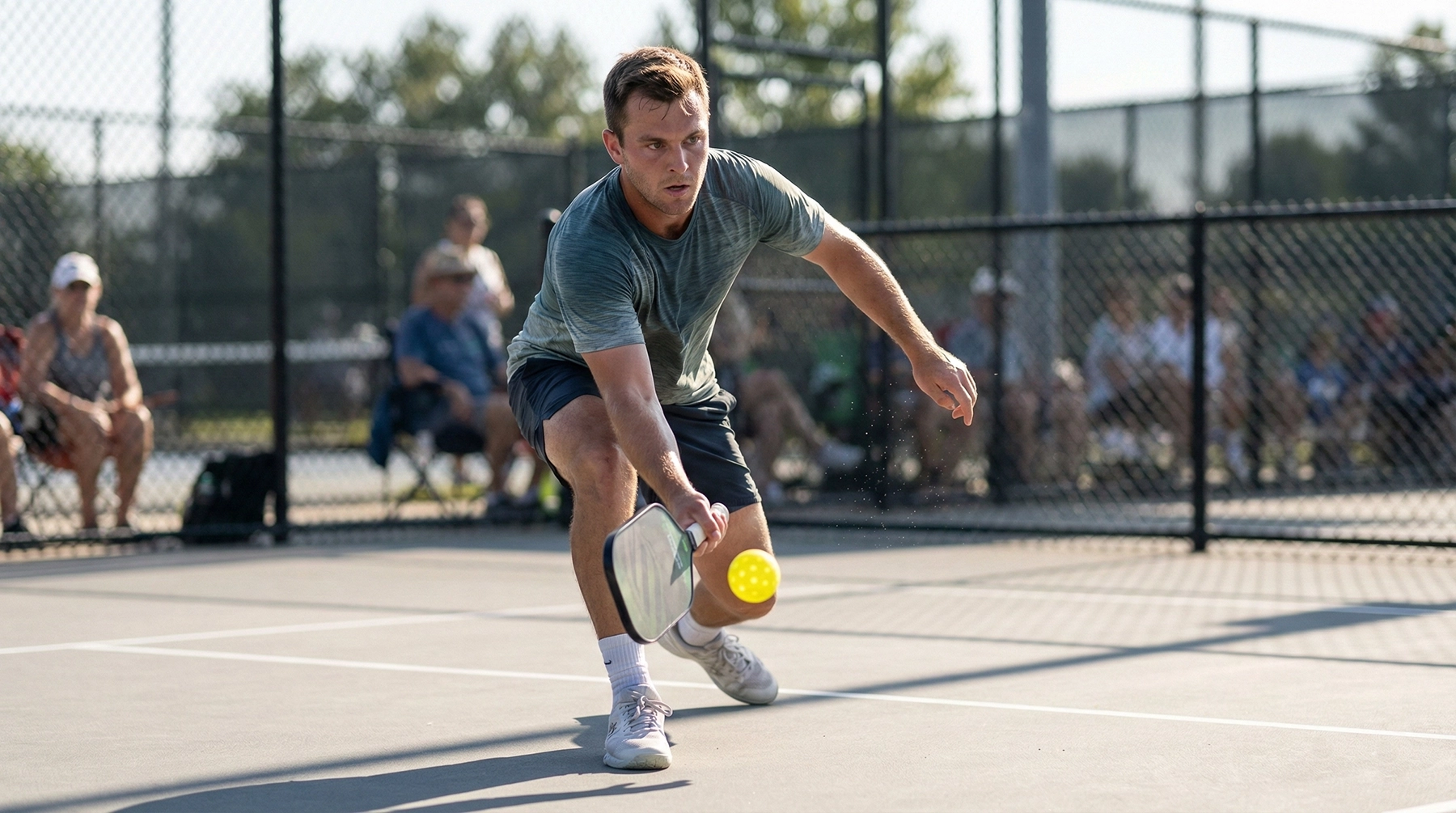
What is Pickleball? A Beginner's Guide
You’ve probably heard the buzz already. Maybe your neighbor won’t stop talking about it, or you’ve noticed those brightly colored courts taking over your local rec center.
So what is pickleball, exactly? It’s America’s fastest-growing sport, and the growth numbers back that up: participation has climbed sharply year over year as courts keep multiplying across the country. What started as a backyard pastime has turned into a genuine national obsession.
But what is it, how do you play, and why is everyone from college students to retirees completely hooked? Here’s the breakdown.
The Short Answer: What is Pickleball?
Pickleball combines the best parts of tennis, ping-pong, and badminton. It’s played on a badminton-sized court (44 by 20 feet) with a low net, solid paddles, and a perforated plastic ball similar to a wiffle ball.
You can play singles or doubles, though doubles is far more common. The game moves fast, it’s highly social, and it’s much easier on the joints than tennis, which explains a lot about who ends up playing it.
Think of it as tennis’s more approachable younger sibling: same strategic depth, less running, more laughing.
How is Pickleball Played? The Complete Breakdown
The Court
A pickleball court measures 44 feet by 20 feet, about the size of a badminton court and roughly a quarter the size of a tennis court. That smaller footprint means less ground to cover, which is a big part of why the sport works for players of every age and fitness level.
The net sits at 36 inches on the sides and drops to 34 inches at the center, slightly lower than a tennis net. That two-inch difference matters more during play than you’d expect.
The Ball
A pickleball is a lightweight, perforated plastic ball, basically a wiffle ball engineered for this specific sport. The holes slow it down just enough to keep rallies going longer, which means more actual gameplay and less time chasing shots across the court.
There are two types: indoor balls (larger holes, softer) and outdoor balls (smaller holes, a bit heavier to cut through wind). If you’re just starting out, grab an outdoor ball: it works on most surfaces.
The Serve
Every point starts with an underhand serve: overhand serves aren’t allowed. The serve has to land in the diagonal service box on the opposite side and clear the kitchen (more on that below).
One rule beginners forget constantly: the server’s feet have to stay behind the baseline when they strike the ball.
The Two-Bounce Rule
This is one of pickleball’s most distinctive rules, and it’s what really separates it from tennis.
After the serve, the ball has to bounce once on the receiving side, then once more on the serving side, before either team can start volleying. Once both bounces have happened, the ball is live and both sides can volley freely.
Why does this rule exist? It kills the serve-and-volley advantage that dominates tennis and forces longer, more strategic rallies, which also keeps the game fair and fun for beginners.
The Kitchen: Pickleball’s Most Famous Rule
Every new player learns this on day one: stay out of the kitchen.
The “kitchen” is the official non-volley zone, a 7-foot area on both sides of the net. You can’t volley the ball (hit it out of the air) while your feet are inside it. Step in and volley, and you lose the point. That’s the whole rule.
Here’s the part that trips people up: you can step into the kitchen to hit a ball that’s already bounced. It’s only volleying from inside the zone that costs you the point.
This is also where the most strategic moments in the game happen. Mastering the soft game, keeping the ball low, forcing opponents back, then attacking, is usually what separates a beginner from an intermediate player.
Scoring
Games typically go to 11 points, win by 2. Tournament play goes to 15 or 21.
The twist most beginners miss: only the serving team can score. If the receiving team wins the rally, they don’t get a point: they get the serve instead. This keeps games close right up to the final point.
In doubles, each team gets two serves (one per player) before serve switches sides, except at the very start of the game, where the first team only gets one. That’s the “side-out” rule, and yes, it confuses nearly everyone at first.
A Brief History: Where Did Pickleball Come From?
Pickleball was invented in the summer of 1965 on Bainbridge Island, Washington, by three dads: Joel Pritchard, Bill Bell, and Barney McCallum. They came home from golf to find their kids bored, so they improvised a game using a badminton court, ping-pong paddles, and a perforated plastic ball.
What began as a lazy afternoon experiment turned into a structured sport within weeks. The first permanent pickleball court went up by 1967, and the USA Pickleball Association (USAPA) was officially founded in 1984.
Today there are over 70,000 pickleball court locations across the US, according to USA Pickleball, and that number keeps climbing.
But Why “Pickleball”?
There are two competing origin stories, and both are worth knowing.
The official version: Joan Pritchard (Joel’s wife) coined the name as a nod to the “pickle boat” in crew racing: a boat assembled from leftover, mismatched rowers, much like how the new sport borrowed pieces from other games.
The funnier (and false) rumor: the game was named after the Pritchard family dog, Pickles. Joel told this version to reporters as a running joke for years. The catch: Pickles the dog was born in 1968, three years after the sport already existed. The dog was named after the game, not the other way around.
Why is Everyone Obsessed With Pickleball?
Few sports manage to be genuinely fun for complete beginners and deeply strategic for advanced players at the same time. Pickleball pulls that off. Here’s why millions of Americans are hooked:
Low barrier to entry. You don’t need to be an elite athlete to enjoy your first game. The smaller court and slower ball mean most people can keep a rally going within 15–20 minutes of picking up a paddle.
It’s social by design. Doubles naturally creates conversation. You’ll meet more people on a court in one afternoon than at a gym in a month, and courts have a reputation for welcoming beginners into games.
Real exercise without the wear and tear. Pickleball raises your heart rate and works your legs and core, but the smaller court means less sprinting, and the underhand serve is far gentler on your shoulders than a tennis serve.
Multi-generational. A 65-year-old retiree and a 25-year-old college athlete can have a genuinely competitive match together. Few sports equalize different fitness levels this well.
Fast to learn, years to master. You’ll have fun on day one. But once you dig into the strategic layers (third shot drops, kitchen battles, stacking), you’ll realize this game goes as deep as you want it to.
Pickleball vs. Tennis: What’s the Real Difference?
Every tennis player asks this eventually. Here’s the honest breakdown:
| Pickleball | Tennis | |
|---|---|---|
| Court Size | 44 x 20 ft | 78 x 36 ft |
| Net Height | 34″ center | 36″ center |
| Serve | Underhand only | Overhand |
| Scoring | To 11 (win by 2) | Games/Sets |
| Learning Curve | 15-30 mins to basics | Weeks to basics |
| Joint Impact | Low | High |
| Social Factor | Very high | Moderate |
Tennis players generally pick pickleball up fast. The hardest adjustment is unlearning the instinct to smash every ball: in pickleball, the soft game wins points far more often than raw power.
What Equipment Do You Need to Start?
The best part about starting: you genuinely don’t need much.
Court shoes: non-negotiable. You need lateral support (side-to-side stability). Running shoes are built for forward motion only and will get you hurt. Dedicated pickleball shoes, or court shoes for tennis or volleyball, both work.
Pickleballs: grab a 3-pack of outdoor balls to start. Durable, widely available, and they work on most surfaces.
A paddle: your only real investment. Skip the cheap wooden paddles; they’re heavy, unforgiving, and tire your arm fast. You don’t need a $250 pro paddle either: a solid fiberglass or composite paddle in the $60–$100 range is the sweet spot for beginners.
Not sure which paddle to buy first? We tested dozens across every budget. Check our complete guide to the Best Pickleball Paddles for Beginners 2026 before you spend a dollar.
Where Can You Play?
Finding a court is easier than ever. With over 70,000 locations across the US, there’s almost certainly one within a few miles of you right now.
The fastest ways to find one:
- USA Pickleball Places2Play map: the official court finder
- Pickleheads app: the most comprehensive court database
- Your local parks and recreation department: many have added courts in the last couple of years
Need help finding courts in your area? Check our guide: Pickleball Courts Near Me: 7 Ways to Find One in 2026
Ready to Start Playing?
Now you know what pickleball is, how it’s played, and why half your neighborhood is already hooked.
The next step is simple: find a court, borrow a paddle, and show up. You’ll be keeping rallies going in your first session, and wondering why you didn’t start sooner.
Your next reads:
