
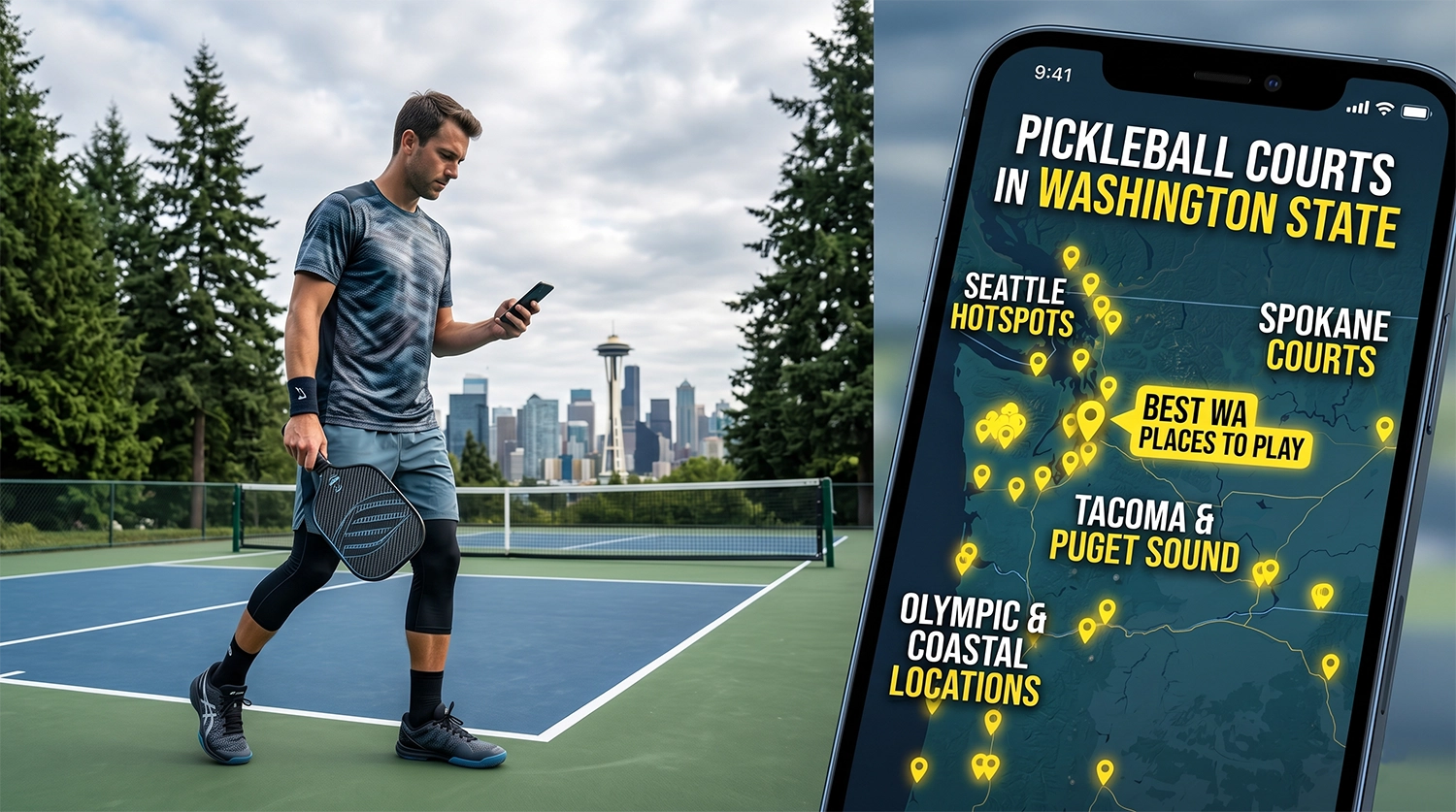
Pickleball Courts in Washington 2026 — The Birthplace of Pickleball — Where It All Started in 1965
Pickleball courts in Washington State carry a unique historical significance: this is where the sport was invented. On a summer afternoon in 1965 on Bainbridge Island — a short ferry ride from Seattle — Joel Pritchard, Bill Bell, and Barney McCallum improvised a backyard game that would become America’s fastest-growing sport six decades later. That origin story gives Washington’s pickleball community a distinct sense of ownership over the sport.
Today, Washington State has over 715 court locations and nearly 3,500 courts, with Seattle leading one of the most active urban pickleball markets on the West Coast. From the original courts on Bainbridge Island to the competitive club scene in Bellevue and the growing Eastern Washington market in Spokane, this guide covers pickleball across the entire state.
Pickleball Courts in Washington State — 2026 Statistics
Washington State ranks seventh nationally in total pickleball court locations and first nationally in per-capita pickleball participation — a distinction that reflects both the sport’s local origins and the state’s broader outdoor recreation culture. The Seattle Parks Department has committed to making Seattle the most pickleball-accessible major city on the West Coast by 2027.
Bainbridge Island, the sport’s birthplace, has four dedicated outdoor courts at Battle Point Park — pilgrimage-worthy for any serious pickleball enthusiast. The island’s courts are free, first-come-first-served, and maintain a reverence in the pickleball community similar to what Augusta represents in golf.
Best Cities for Pickleball in Washington
Washington State’s pickleball divides naturally between the rainy Puget Sound region (dominated by Seattle) and the drier, sunnier Eastern Washington market centered on Spokane.
Seattle's pickleball scene operates under the constraint of the city's infamous rain — which has driven investment in indoor facilities and covered outdoor courts that no other major city can match. Lower Woodland Park has 12 dedicated courts and is Seattle's most popular public pickleball venue. Rainier Beach and Georgetown neighborhoods have seen significant court expansion. The Seattle Pickleball Club organizes competitive play across the metro area.
Bainbridge Island is the most historically significant pickleball destination in the world. Battle Point Park has 4 dedicated courts on the same island where the sport was created in 1965. The ferry from Seattle Waterfront to Winslow takes 35 minutes and the courts are a 10-minute bike ride from the terminal. Visit once for the history — the setting and community make it worth the trip.
Bellevue and the Eastside suburbs (Kirkland, Redmond, Issaquah) have the strongest indoor pickleball infrastructure in the state — a necessity given rainfall levels. Multiple private clubs, the KingCo Athletic complex, and several converted racquet facilities provide year-round indoor access. Microsoft and Amazon employees have driven significant recreational pickleball investment in this corridor.
Spokane's Eastern Washington location gives it significantly more sunshine and drier weather than the Puget Sound region — averaging only 17 inches of rain per year versus Seattle's 38 inches. Riverfront Park has 10 outdoor courts open April through October. The Spokane Club and multiple athletic facilities provide indoor year-round options. Spokane hosts several major regional tournaments annually.
Tacoma and Pierce County have some of the most organized community pickleball infrastructure in the state, with the Metropolitan Parks District running structured leagues for all skill levels. Wright Park has 8 dedicated outdoor courts, and the Sprinker Recreation Center offers indoor access year-round.
Tips for Playing Pickleball in Washington
Seattle, Bainbridge, Bellevue, and Tacoma receive significant rainfall October through May. Planning for indoor courts is essential for consistent year-round play on the west side of the Cascades. Eastern Washington (Spokane) has far better outdoor conditions nine months of the year.
Battle Point Park on Bainbridge Island is a pickleball pilgrimage destination. The ferry from downtown Seattle Waterfront (Pier 52) to Winslow takes 35 minutes and costs $9 round-trip for foot passengers. Courts are free and first-come-first-served. The community is welcoming to visiting players, especially those who mention the sport's history.
At busy Seattle courts, a paddle queue determines play order — place your paddle on the designated fence hook or queue board when you arrive, and wait for your number. Never jump the queue; the community takes this seriously. Ask a regular player to explain the system at your specific court if unclear.
Spokane and the Tri-Cities (Richland, Kennewick, Pasco) offer significantly better outdoor playing conditions than Seattle, less crowded courts, and a growing competitive scene. If you are visiting Eastern Washington, the pickleball infrastructure is genuinely excellent.
The right paddle and shoes make all the difference on Washington courts. Here are our tested recommendations before your first session.
Pickleball Was Invented Here — The Washington State Origin Story
Pickleball courts in Washington State continue to grow in number every year across all major regions.
No other state in the country can claim what Washington State claims: pickleball was born here. On a summer afternoon in 1965 on Bainbridge Island — a 35-minute ferry ride from Seattle — Joel Pritchard, Bill Bell, and Barney McCallum improvised a backyard game for their bored children using a badminton court, ping-pong paddles, and a perforated plastic ball. Within weeks, what started as a lazy afternoon experiment had a defined ruleset. Within two years, the first permanent pickleball court in history was built at Bob O’Brian’s house, just blocks from where the game was created.
The sport grew quietly for two decades. The USA Pickleball Association was founded in 1984. The first official rulebook was published. Tournaments began. And then — starting around 2018 — the sport exploded nationally at a rate that nobody predicted. USA Pickleball reported a 223% participation increase in three years. By 2026, nearly 20 million Americans are playing the game that three Washington State fathers invented to keep their kids entertained on a summer afternoon.
Washington State’s pickleball community carries this history with a quiet pride. When you play on Bainbridge Island’s Battle Point Park courts, you are playing on the same island where it all started. When Seattle players argue about the kitchen line or debate the merit of the third shot drop, they are having conversations that originated in the backyard of a Bainbridge Island home six decades ago.
That origin story gives Washington State a unique place in every pickleball conversation — and it is the primary reason serious players from across the country make the pilgrimage to Bainbridge Island at least once.
Whether you are looking for pickleball courts in Washington State near Seattle, Spokane, or Bainbridge Island, this guide covers every region with real court counts and local tips. Finding pickleball courts in Washington State has never been
easier thanks to the USA Pickleball directory and Pickleheads.
How to Find Pickleball Courts Near You in Washington State
Finding pickleball courts near you in Washington State requires different strategies depending on which side of the Cascades you are on.
Western Washington (Seattle, Bellevue, Tacoma, Bainbridge): The Seattle Parks app is the primary tool for booking courts in the city. Lower Woodland Park, Rainier Beach, and other city courts require advance booking through the app — walk-up availability exists but is unreliable at peak times. Bellevue and Kirkland courts are managed through the Bellevue Parks system separately. For indoor pickleball courts near you in the Puget Sound region, the YMCA network and private athletic clubs are the most reliable year-round options given the region’s rainfall.
Eastern Washington (Spokane, Tri-Cities, Yakima): Court access is significantly more casual on the east side of the Cascades. Riverfront Park in Spokane and most Tri-Cities facilities are walk-up friendly, and the drier climate means outdoor courts are available approximately nine months per year. The Spokane Parks Department app manages reservations at its larger facilities.
Bainbridge Island specifically: Battle Point Park courts are free, first-come-first-served, and have no reservation system. The ferry from Seattle Waterfront (Pier 52) runs every 35-50 minutes. Total round-trip cost for foot passengers is approximately $9. Courts open at sunrise and close at dusk. Weekday morning visits avoid the weekend crowds that the island’s historical significance attracts.
Pickleball Courts in Washington — Frequently Asked Questions
Was pickleball really invented in Washington State?
Yes. Pickleball was invented in the summer of 1965 on Bainbridge Island, Washington, by Joel Pritchard, Bill Bell, and Barney McCallum. Battle Point Park on Bainbridge Island has dedicated courts on the island where the sport originated.
Where is the best pickleball in Seattle?
Lower Woodland Park in Seattle has 12 dedicated courts and is the city’s most popular public venue. Bellevue’s indoor facilities are the best in the region for year-round play. Bainbridge Island’s Battle Point Park is historically significant and worth the ferry trip.
Can I play pickleball year-round in Washington State?
Yes, with the right resources. Western Washington requires indoor facilities October through May due to rainfall. Eastern Washington (Spokane) has excellent outdoor playing conditions most of the year. All major cities have indoor options.
How far is the birthplace of pickleball from Seattle?
Bainbridge Island is a 35-minute ferry ride from Seattle Waterfront (Pier 52). The ferry costs approximately $9 round-trip for foot passengers. Battle Point Park, where the sport was invented, is about 10 minutes by bike or taxi from the Winslow ferry terminal.
