
Pickleball Rules Explained: The Complete 2026 Rulebook
“Pickleball rules” gets searched about 74,000 times a month, and yet ask five players at your local court what the two-bounce rule actually means and you’ll probably get five different answers. Most of that confusion comes from the fact that the only “official” source is a 100-plus-page USA Pickleball rulebook written for tournament referees, not for someone who just wants to know why they can’t smash the return.
This guide is the plain-English version. Every rule is explained the way it actually gets enforced on a rec-center court, cited straight back to USA Pickleball, and updated for the rulebook that took effect January 1, 2026.
New to the sport entirely? Start with our How to Play Pickleball for Beginners guide first, then come back here when you want the full rulebook depth.
- Pickleball runs on 5 core rules: underhand serve, the two-bounce rule, no volleying in the kitchen, games to 11 win-by-2, and only the serving team scores.
- USA Pickleball's 2026 rulebook took effect January 1, 2026, with six real changes, but the scoring system nearly everyone actually plays (side-out scoring) is not one of them.
- The most commonly cited beginner faults are the two-bounce violation, kitchen volleys, foot faults, and out-of-bounds hits.
What Are the 5 Core Rules of Pickleball?
Pickleball rules boil down to exactly 5 core ones that govern 90% of what happens in a casual game: the underhand serve, the two-bounce rule, the no-volley kitchen rule, scoring to 11 win-by-2, and the rule that only the serving side can score. Everything else in the rulebook is a variation or clarification of these five.
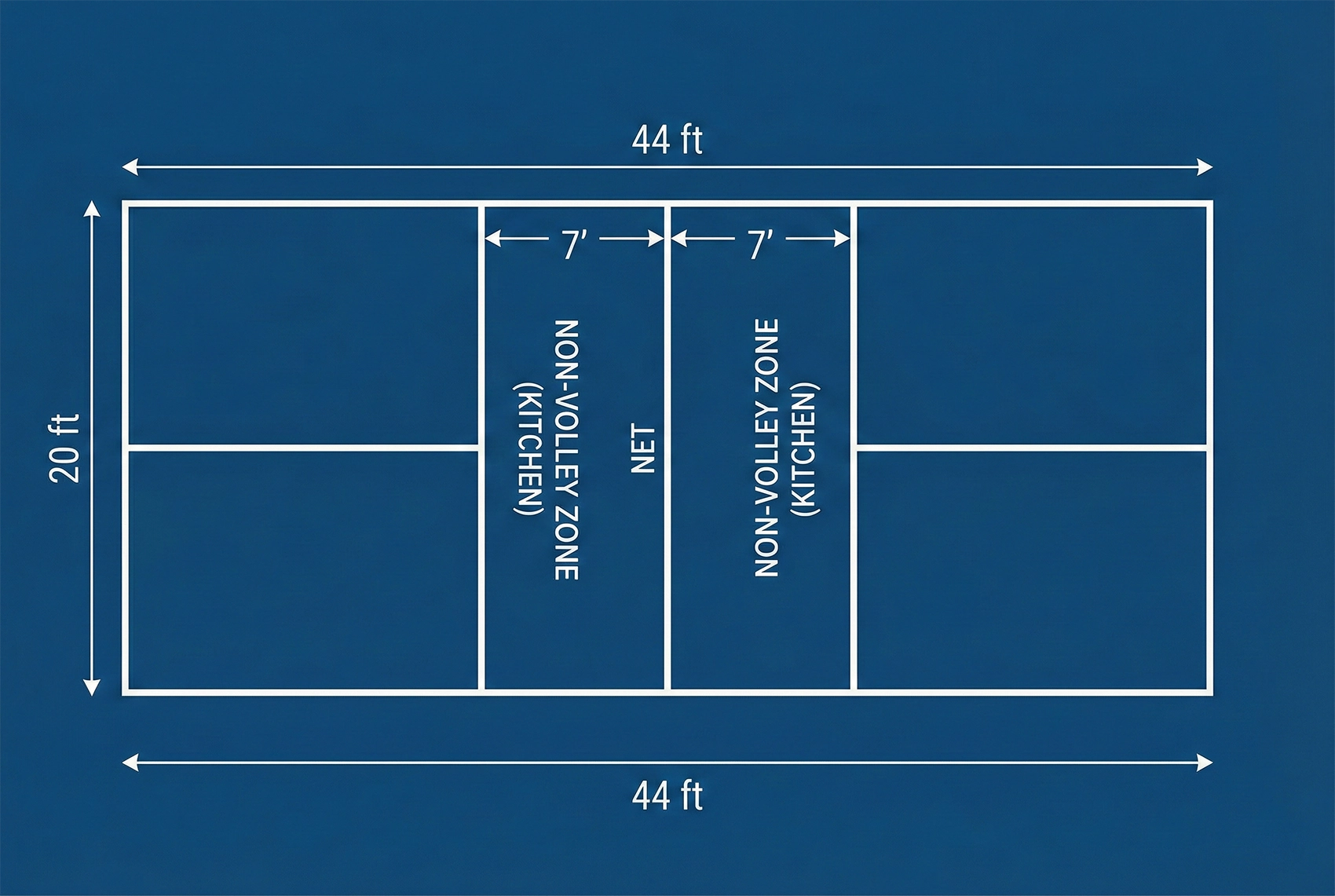
Here’s the quick version of each, with a deeper breakdown of every one further down this page:
- The serve has to be underhand, contact below the waist, and land diagonally in the opponent’s service box.
- The two-bounce rule forces one bounce on each side before anyone can volley.
- The kitchen (non-volley zone) is a 7-foot no-fly zone for volleys on both sides of the net.
- Scoring goes to 11, win by 2, in most recreational and tournament play.
- Only the serving team can add to the score, win a rally on return and you get the serve, not a point.
USA Pickleball has been the sport’s sole governing body since 1984, and its rulebook is the actual legal text every one of these rules traces back to. We’ll cite it directly throughout this guide instead of paraphrasing secondhand summaries.
New to the sport? Learn what pickleball is before diving into rule specifics.
Pickleball Serving Rules, Explained in Full
The 2026 USAPA rulebook added the word “clearly” to all three volley serve requirements, specifically to cut down on illegal sidearm serves that were hard for referees to call consistently (USA Pickleball, 2026). That single word changes how strictly your serve motion gets judged, even in casual play where nobody’s officiating.
The full serve rule has four parts. Miss any one and it’s a fault:
- Underhand contact: the paddle has to strike the ball below your waist, specifically below the navel.
- The diagonal: the serve has to land in the opponent’s diagonal service box, never straight across.
- Foot placement: at least one foot stays behind the baseline at contact.
- The let serve: if the ball clips the net and still lands in the correct box, play continues. It’s a live ball, not a redo.
Serving faults are consistently named as one of the most common beginner mistakes across pickleball coaching resources, right alongside forgetting the two-bounce rule entirely (Pickleheads; JustPaddles). Why? Because a tennis background actively works against you here. Tennis players default to an overhand motion their whole life, and unlearning that instinct takes real reps.
Curious how the score actually gets called after the serve? That’s covered start to finish in our complete scoring breakdown rather than duplicated here.
The Two-Bounce Rule: Why It Exists and How It Works
The two-bounce rule requires the ball to bounce once on the receiving side and once more on the serving side before either team can volley it. Skip a bounce and it’s a fault. This single rule is what separates pickleball from tennis more than any other, and it’s the one that trips up crossover tennis players hardest.
Here’s the sequence:
- Bounce 1: the receiver must let the serve bounce before returning it. No catching it out of the air.
- Bounce 2: the serving team must then let that return bounce before hitting it back.
- After that: it’s open season. Volley it or play it off the bounce, your call.
Why does this exist at all? It kills the serve-and-volley advantage that dominates tennis, forcing at least two ground strokes before anyone can crowd the net. That single design choice is a big part of why rallies in pickleball run longer and feel more strategic than a raw power contest.
Along with kitchen violations, forgetting the two-bounce rule is repeatedly named as one of the top beginner faults across pickleball instructional content (Pickleheads, 2026). If you’re still catching yourself volleying too early, you’re in good company. Nearly every player made this exact mistake in their first few sessions.
Pickleball Kitchen Rules: Every Non-Volley Zone Violation Explained
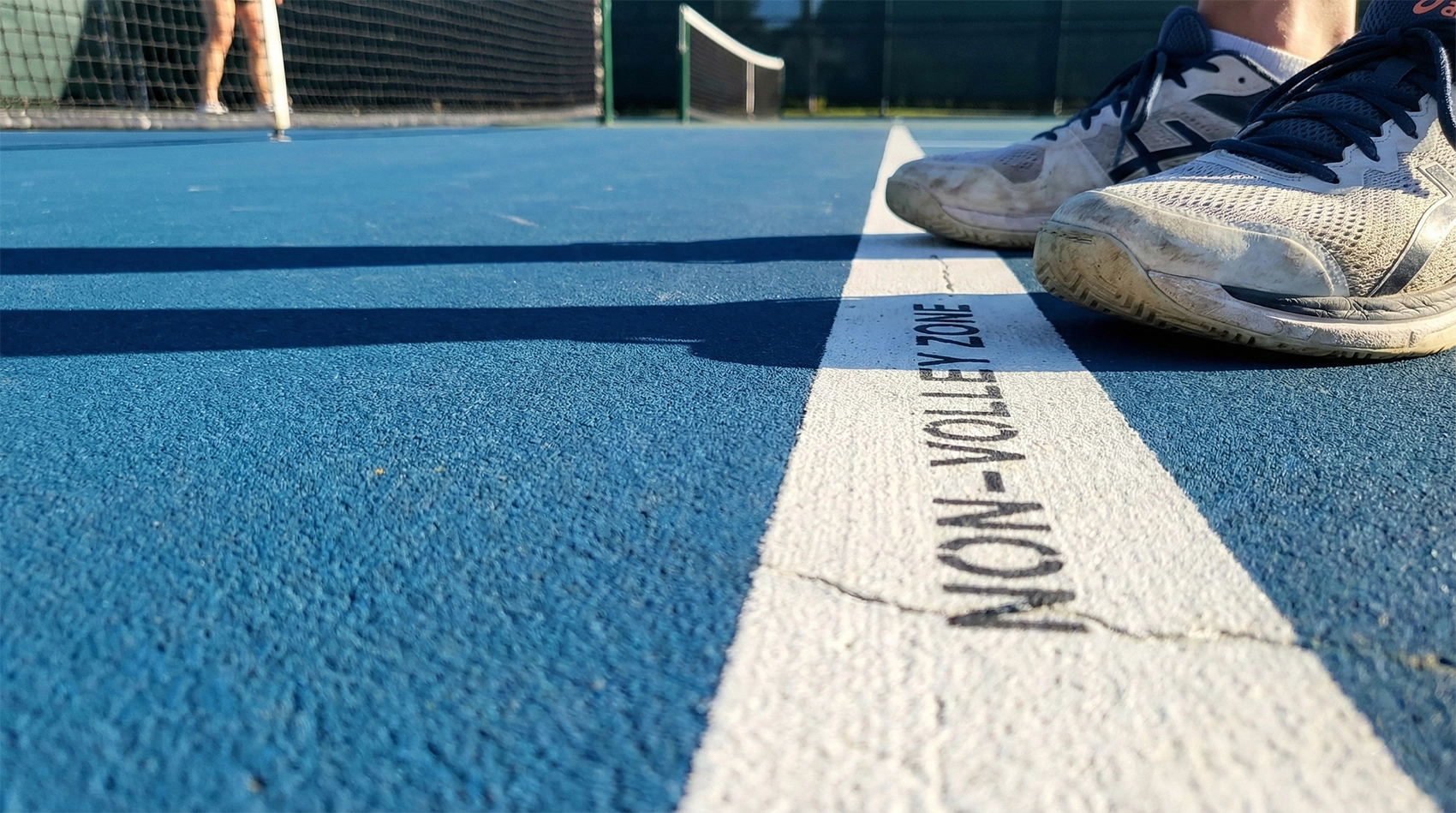
The kitchen, officially the non-volley zone, is where most beginners commit their first fault. It’s a 7-foot strip on both sides of the net, and the core rule is simple: you cannot volley the ball while any part of you touches that zone or its line.
A 2026 rulebook clarification actually tightened the definition of when a “volley” begins. The volleying action now officially starts at the moment the ball is struck, not during your backswing or approach into the zone (The Dink Pickleball, 2026). That matters because it means stepping toward the kitchen before contact isn’t automatically a fault the way some players assumed under the older wording.
The specific violations that count as faults:
- Volleying while standing in the kitchen.
- Volleying while touching the kitchen line, even with just a toe.
- Momentum carrying you into the kitchen right after a volley, even if you were outside it at contact.
The one exception everyone forgets: you’re allowed to step into the kitchen to play a ball that has already bounced. It’s only volleying from inside the zone that costs you the point. Beginners get so cautious about the rule that they avoid the kitchen entirely, even when it’s completely safe to be there.
Illustrative ranking of the faults most consistently named across pickleball coaching resources. Source: Pickleheads, JustPaddles, 2026.
Pickleball Faults: The Complete List of What Costs You the Point
A fault in pickleball is any rule violation that immediately ends the rally, and it either costs the offending side the point or the serve. The four most common categories, per pickleball coaching resources, are the two-bounce violation, out-of-bounds hits, foot faults, and kitchen volleys, all covered in detail above.
Beyond those, the full fault list includes:
- Hitting the ball out of bounds or into the net.
- Volleying from inside the non-volley zone.
- Volleying before the ball has bounced once on each side after the serve.
- The ball touching you or your clothing, even before it bounces, in bounds or not.
- A serve landing in the kitchen, including on the kitchen line.
One genuinely new wrinkle for 2026: net-post contact. If the ball legally clears the net, bounces inbounds, and then spins or blows into the net post afterward, the rally ends in favor of the hitter, not an automatic fault the way some players assumed under the old reading (USA Pickleball Rulebook Change Document, 2026). The rule exists specifically to stop players from wrongly claiming “it hit the post, so it’s dead” on a ball that already legally scored.
Pickleball Rule Changes for 2026: What's Actually New
USA Pickleball’s updated 2026 rules took effect January 1, 2026. Before listing what changed, here’s the distinction that matters most if you’re a recreational or beginner player: two different scoring systems exist in pickleball, and only one of them saw a real change.
Side-out scoring is the default. It’s what the vast majority of recreational and beginner play uses: only the serving team can score, games run to 11, win by 2. This is exactly what our How to Play Pickleball for Beginners guide already teaches, and it did not change in 2026. Nothing about how you keep score in your Tuesday-night open play session is different this year.
Rally scoring is a separate, optional format where a point counts on every rally regardless of who served, including at game point. It carries provisional status through a 2027 review, gets used only when a tournament director specifically chooses it, and is explicitly banned in double-elimination doubles events, every 2026 USA Pickleball Golden Ticket event, and the 2026 USA Pickleball National Championship (Rally Racket; JudgeMate, 2026).
The eliminated “freeze rule” you may have heard about lives entirely inside that optional rally-scoring format. Previously, even under rally scoring, only the serving team could win at game point; that restriction is gone now. It never touched side-out scoring, and it still doesn’t.
| Side-Out Scoring (Default, What This Site Teaches) | Rally Scoring (Optional, Provisional Through 2027) |
|---|---|
| Used in nearly all recreational and beginner play | Used only when a tournament director elects it |
| Only the serving team can score | Either team can score on any rally |
| Unchanged in 2026 | "Freeze rule" at game point eliminated in 2026 |
| Standard everywhere, no restrictions | Banned in double-elimination, Golden Ticket, and National Championship events |
The rest of the 2026 changes apply broadly, no scoring caveat needed:
- Out calls must now be made promptly. Wait too long after a ball bounces twice, hits you, or gets caught, and the late call won’t be recognized.
- Net post contact, covered above, no longer causes an automatic fault after a legal bounce.
- Adaptive standing division: Section 25 now covers players with permanent balance or mobility limitations, alongside existing wheelchair divisions.
If you only remember one thing from this section, make it this: unless you’re specifically entering a tournament that’s announced rally scoring, you’re playing side-out scoring exactly the way you always have.
Are Pickleball Rules the Same as Tennis?
No. The underhand serve, the two-bounce rule, and the non-volley zone have zero equivalent in tennis, and they’re the three biggest adjustments tennis players have to make. Everything else, court positioning, general strategy, feels familiar fast.
The quick rules-specific differences:
- Serve motion: underhand only in pickleball, versus overhand in tennis.
- Volley restrictions: pickleball’s two-bounce rule and kitchen zone don’t exist in tennis at all.
- Scoring structure: games to 11 win-by-2, versus tennis’s game/set structure.
Want the fuller side-by-side, including court size and net height? Our What is Pickleball? guide has the complete comparison table. This section is about the rules specifically, not the whole sport.
Pickleball Rules, FAQ
The 5 core rules are the underhand serve, the two-bounce rule, no volleying in the kitchen (non-volley zone), games to 11 win by 2, and only the serving team can score. Every other rule in the USAPA rulebook is a variation of these five (USA Pickleball, 2026).
A fault is any rule violation that immediately ends the rally, costing the offending side the point or the serve. The most commonly cited beginner faults are kitchen volleys and two-bounce violations (Pickleheads, 2026).
USA Pickleball’s 2026 rulebook, effective January 1, made six changes, including a serving wording update and a net-post clarification. The most talked-about change, the freeze-rule elimination, applies only to the optional rally-scoring format, not to the side-out scoring most players use (Rally Racket, 2026).
No. The underhand serve, two-bounce rule, and non-volley zone have no tennis equivalent, and they’re the three adjustments tennis players notice first when they switch over.
The serving sequence and full three-number scoring format are covered start to finish in our Pickleball Scoring Explained guide, since that deserves its own complete walkthrough rather than a short answer here.
Ready to Put These Rules Into Practice?
You now know the five core pickleball rules, the most common faults to avoid, and exactly what did and didn’t change for 2026. That’s more rulebook depth than most players ever bother to learn, and it’ll save you at least one argument on the court.
