
How Did Pickleball Get Its Name? The Best 2026 Story
How did pickleball get its name is one of the most asked questions about the sport, right alongside when was pickleball invented, and the honest answer to both involves a bit of 1960s improvisation, a badminton net, and a family dog whose role in the story is more disputed than most people realize.
If you already know the basics and want to jump straight into playing, our what is pickleball guide covers the modern rules. This article focuses purely on where the sport actually came from and how a backyard invention turned into one of the fastest-growing sports in the country.
When and Where Pickleball Was Invented (1965)
The story of how did pickleball get its name starts before the name itself existed. Pickleball was invented in the summer of 1965 on Bainbridge Island, Washington, by three fathers, Joel Pritchard, Bill Bell, and Barney McCallum, who were looking for a way to entertain their bored kids on a weekend with the family’s badminton set missing a few pieces.
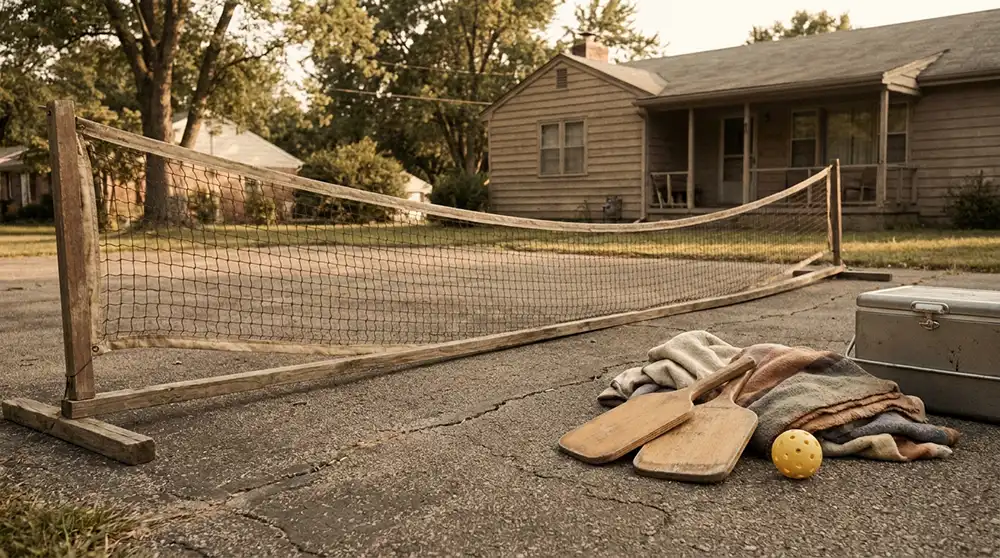
With no complete set of badminton equipment available, they improvised with ping-pong paddles and a perforated plastic ball, lowered the badminton net, and started playing on an old badminton court. The rules evolved over that summer through trial and error rather than being designed from scratch, which explains why the sport still carries a slightly patchwork feel of borrowed elements from tennis, badminton, and table tennis.
By the following year, in 1967, the first permanent pickleball court was built specifically for the game on Bainbridge Island, marking the point where it stopped being a one-off backyard activity and started becoming an actual sport with dedicated infrastructure.
The Real Story Behind the Name
How did pickleball get its name is where the history gets genuinely contested. Two competing origin stories have circulated for decades, and neither has fully settled the debate.
The “pickle boat” theory. Joel Pritchard’s wife, Joan Pritchard, is often credited with explaining that the name came from the term “pickle boat” in competitive rowing, referring to a boat crewed with leftover oarsmen assembled from the other boats’ castoffs. The idea was that pickleball itself was cobbled together from parts of other sports, much like a pickle boat crew.
The dog theory. The more popular, folksier version claims the Pritchards’ dog, named Pickles, used to chase after stray balls during games and run off with them, and the family started calling it “Pickles’ ball,” which eventually shortened to pickleball.
Records suggest the Pritchard family did not actually get their dog Pickles until a couple of years after the sport was already named, which casts real doubt on the dog story despite how widely it gets repeated. Joan Pritchard’s own explanation, tied to the rowing term, is generally considered the more historically credible version, though the dog story remains far more popular in casual retellings simply because it makes for a better anecdote.
How Pickleball Evolved Into a Sport
Long after the question of how did pickleball get its name was settled among the founding families, the transition from backyard game to organized sport took a few key steps over the following decades. In 1972, a corporation was formed specifically to protect the sport’s name and rules, an early sign the founders recognized it had real staying power beyond their own families.
The first official rulebook was published in 1984, and the USA Pickleball Association, now known simply as USA Pickleball, was founded that same year to standardize rules, sanction tournaments, and grow the sport nationally. This governing body still oversees the official rulebook today, including the updates that took effect in 2026.
Growth stayed relatively modest for decades, largely popular in Pacific Northwest retirement communities, before accelerating sharply starting in the 2010s as social media exposure and celebrity attention brought the sport to a much younger, broader audience.
Pickleball's Explosive Growth in Recent Years
The story of how did pickleball get its name feels almost quaint next to what the sport has since become. What started as a solution to a bored-kids problem on one island has become one of the fastest-growing sports in the United States by participation numbers. Millions of Americans now play regularly, a dramatic shift from the sport’s niche retirement-community reputation just a decade ago.
For a full breakdown of current participation numbers, court counts, and demographic trends, see our pickleball statistics guide, which covers exactly how far the sport has come since those three families started improvising on a badminton court in 1965.
Professional leagues, major sponsorship deals, and dedicated pickleball facilities being built across the country all mark just how far the sport has traveled from its improvised origins, a trajectory none of the three original founders could have reasonably predicted from a single summer weekend.
What makes the story genuinely remarkable in hindsight is how little planning went into any of it. There was no business plan, no attempt to trademark or franchise the concept early on, just three families who kept playing a game they had cobbled together, refining the rules purely because it turned out to be more fun than anyone expected.
Key Milestones in Pickleball History
A quick timeline covering both when pickleball was invented and how did pickleball get its name fits into the sport’s broader development:
1965: Pickleball invented on Bainbridge Island by Joel Pritchard, Bill Bell, and Barney McCallum.
1967: First permanent pickleball court built.
1972: A corporation formed to protect the sport’s name and rules.
1984: First official rulebook published and USA Pickleball founded.
1990: Pickleball reaches all 50 states.
2010s: Rapid growth accelerates through social media exposure and celebrity involvement.
2020s: Pickleball becomes one of the fastest-growing sports in the country, with professional leagues and major sponsorships emerging.
Other Pickleball Name Theories Worth Knowing
Beyond the two dominant explanations, a few other, less common theories have circulated over the decades whenever someone asks how did pickleball get its name.
The condiment theory. Some early accounts suggested the name was simply a lighthearted, silly choice meant to sound fun and approachable, similar to how many backyard games of that era picked playful, food-related names without much deeper meaning attached.
The mixed-sport theory. A variation on the pickle boat explanation suggests the name reflected the game itself being a mix, or “pickle,” of borrowed elements from badminton, tennis, and table tennis, rather than specifically referencing the rowing term.
None of these alternate theories have the same level of family testimony behind them as the two main stories, but they show just how much genuine uncertainty still surrounds the exact naming decision nearly six decades later.
Who Were the Three Founders of Pickleball?
Understanding how did pickleball get its name also means understanding who was there that day in 1965 to name it in the first place.
Joel Pritchard was a Washington State congressman at the time and later served as the state’s lieutenant governor. He is generally credited as the primary organizer of that first improvised game weekend.
Bill Bell was a local businessman and friend of the Pritchard family, present for the original games and credited alongside Pritchard for adapting the rules as they went.
Barney McCallum joined the following weekend after hearing about the new game, and is credited with helping formalize the earliest written rules, moving the game from pure improvisation toward something more consistent and repeatable.
All three men are recognized as co-founders, and their families remained closely tied to the sport’s early growth for decades afterward, well before anyone involved could have predicted pickleball would eventually become a nationally recognized sport with professional leagues.
Joan Pritchard, Joel’s wife, is often left out of the “three founders” framing but deserves real credit too. Her account of the pickle boat naming explanation remains the closest thing historians have to a primary source on how did pickleball get its name, and she was actively involved in those early games alongside her husband and their friends.
Frequently Asked Questions
Common questions about pickleball’s history and how it got its name.
When was pickleball invented?
Pickleball was invented in the summer of 1965 on Bainbridge Island, Washington, by Joel Pritchard, Bill Bell, and Barney McCallum.
How did pickleball get its name for certain?
The most historically credible explanation, from Joan Pritchard, ties the name to the rowing term ‘pickle boat,’ referring to a crew assembled from leftover players. The popular story about a dog named Pickles is widely repeated but disputed by the timeline of when the family actually got the dog.
Who invented pickleball?
Three fathers, Joel Pritchard, Bill Bell, and Barney McCallum, invented the game in 1965 while looking for a way to entertain their families on Bainbridge Island.
Was pickleball originally played with badminton equipment?
Yes. The very first games used ping-pong paddles and a perforated plastic ball on a lowered badminton net, since the original badminton set was missing pieces.
When did pickleball become an official sport?
1984 is generally considered the turning point, when the first official rulebook was published and USA Pickleball was founded to standardize rules nationally.
Why did pickleball become so popular recently?
Social media exposure, celebrity involvement, and the sport’s low barrier to entry compared to tennis all contributed to rapid growth starting in the 2010s and accelerating through the 2020s.
How did pickleball get its name and when was pickleball invented both trace back to the same improvised summer afternoon in 1965, when three families turned a missing badminton set into the foundation of a sport now played by millions. The dog story might be the version most people repeat, but the rowing term explanation carries the stronger historical evidence, even if it makes for a slightly less charming anecdote at a dinner party.
Either way, the sport’s accidental, improvised origins seem fitting given how quickly and unexpectedly it has grown well beyond anything its three founders were originally trying to build.
