
Pickleball vs Tennis: The Best 2026 Comparison
Pickleball vs tennis comes up constantly among players deciding which racquet sport to pick up, and the honest answer is that they share a family resemblance but play very differently once you are actually on the court. Pickleball uses a smaller court, a slower ball, and shorter rallies built around finesse near the net. Tennis rewards power, endurance, and a much larger playing area.
If you already know pickleball is the direction you want to go, our beginner paddle guide is a good next stop. This comparison breaks down the real differences in court size, rules, physical demands, and how easily skills transfer between the two sports.
Court Size and Equipment Differences
A pickleball court measures 20 by 44 feet, roughly the size of a doubles badminton court, and is small enough that all four players in a doubles match can comfortably fit inside a standard tennis court’s doubles alley with room to spare. A tennis court measures 78 by 36 feet for doubles, nearly three times the total playing area.
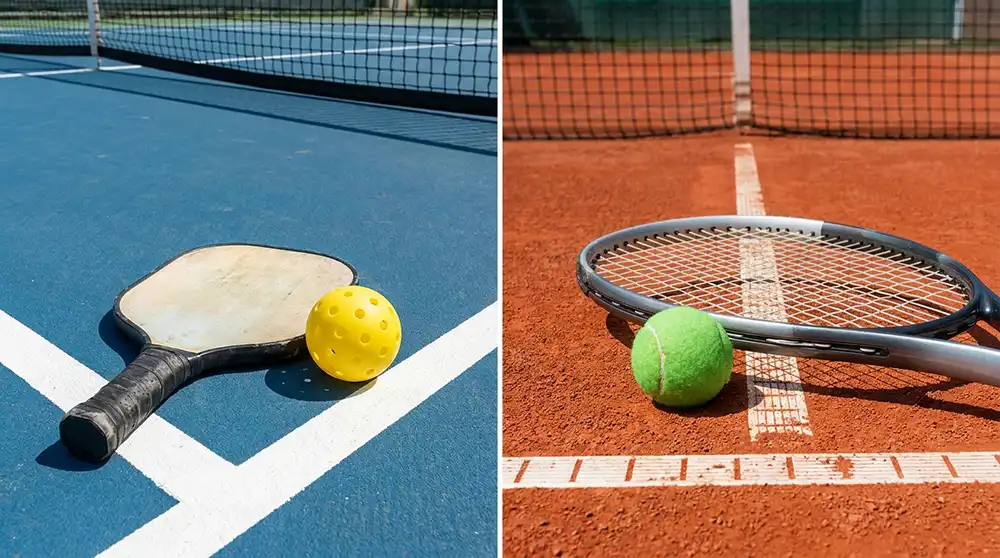
Equipment differs just as much. Pickleball paddles are solid, typically made from a composite or carbon fiber face over a polymer core, with no strings at all. Tennis racquets use a strung frame designed to generate spin and power over long groundstrokes. The pickleball ball itself is a hollow, perforated plastic ball similar to a wiffle ball, while a tennis ball is a pressurized felt-covered rubber ball built for a completely different kind of impact.
Net height is another subtle but real difference in the pickleball vs tennis comparison: a pickleball net sits at 34 inches at the center, slightly lower than a tennis net’s 36-inch center height, which along with the smaller ball affects how shots are shaped near the net on each court.
Rules and Scoring Compared
One of the clearest rule differences in pickleball vs tennis is scoring: pickleball runs to 11 points, win by 2, with only the serving side able to score in traditional scoring. Tennis uses a game, set, and match structure with its own quirky point system (15, 30, 40, game) that takes new players a while to memorize.
The biggest structural difference is the non-volley zone, or kitchen, in pickleball: a seven-foot area on each side of the net where volleying (hitting the ball out of the air) is not allowed. Tennis has no equivalent zone. This single rule is why pickleball rallies often turn into soft, patient dinking exchanges near the net rather than the powerful baseline rallies common in tennis.
Both sports share the two-bounce concept loosely, pickleball requires the ball to bounce once on each side before volleys are allowed (the two-bounce rule), while tennis has no such requirement once the point is underway.
Which Sport Is Easier to Learn?
When it comes to learning curve, pickleball vs tennis is not close for absolute beginners, pickleball is noticeably easier to pick up. The smaller court means less ground to cover, the underhand serve is easier to execute consistently than a tennis serve, and the slower ball gives new players more time to react. Most beginners can rally casually within their first session.
Tennis demands more from day one. The overhead serve alone takes real practice to execute consistently, and generating clean, controlled groundstrokes with a strung racquet against a much faster ball has a steeper initial learning curve. Tennis rewards years of technical refinement in a way pickleball’s shorter, softer game does not require to simply enjoy playing.
That said, pickleball’s ceiling is deeper than casual players often assume. The soft game near the kitchen line, spin control, and strategic shot placement take real time to master even after the basics click.
Physical Demands: Which Is Better Exercise?
Tennis is the more physically demanding sport overall. Covering a larger court, generating power on serves and groundstrokes, and sustaining longer rallies burns more calories per hour and places greater cardiovascular and joint demand on players, particularly the shoulders and knees.
Pickleball is lower impact by design, which is a major reason it has grown so quickly among older adults and players returning from injury. Rallies are shorter, the court is smaller, and movement tends to be lateral shuffling near the net rather than full-court sprints. That said, pickleball is far from a passive activity, competitive matches still elevate heart rate meaningfully and build genuine agility and reaction-time benefits.
Neither sport is objectively “better” exercise, the right answer depends on joint health, fitness goals, and how much intensity a player is looking for.
A useful way to frame the pickleball vs tennis fitness comparison: tennis trains explosive power and sustained cardio over longer points, while pickleball trains quick reflexes, hand-eye precision, and shorter bursts of lateral movement. Both build real fitness, just along different physical dimensions.
Can Tennis Players Switch to Pickleball Easily?
For anyone weighing pickleball vs tennis after already playing one sport, tennis players usually adapt to pickleball quickly, often within a few sessions, because hand-eye coordination, court awareness, and basic racquet-sport instincts transfer directly. The most common adjustment is toning down power. Tennis players instinctively swing hard, which sends a lightweight pickleball flying out of bounds far more often than a tennis ball would.
The other major adjustment is patience at the net. Tennis rewards aggressive net play when the opportunity arises, while pickleball’s kitchen rule and softer ball favor a more controlled, dink-heavy approach that feels counterintuitive to players used to swinging through every shot.
Former tennis players typically bring an advantage in serve consistency, court positioning, and general competitiveness, but should expect a short adjustment period specifically around shot power and patience near the net.
Cost and Accessibility Compared
On cost, pickleball vs tennis favors pickleball clearly, it is generally cheaper to start. A decent beginner paddle runs $30 to $80, compared to $80 to $200 or more for a quality tennis racquet, and pickleball courts are increasingly common at public parks, often free to use, since many were converted from underused tennis courts.
Court access varies heavily by region for both sports, but pickleball’s smaller footprint has made it easier for parks departments and clubs to add courts quickly, often by simply repainting lines on an existing tennis or basketball court, which has accelerated its availability faster than new tennis court construction typically allows.
Pickleball vs Tennis: Which Should You Choose?
When deciding between pickleball vs tennis, a few honest questions narrow it down faster than any feature comparison.
Choose pickleball if: you want a faster learning curve, lower joint impact, a social doubles-focused game, and a cheaper entry cost. It is also the stronger choice if you are returning to sports after time away or introducing an older family member to a new activity.
Choose tennis if: you want a more intense cardiovascular workout, are drawn to the sport’s deep competitive and professional infrastructure, or already have access to tennis coaching and courts in your area.
Consider both if: you want variety in your training, tennis for power and conditioning, pickleball for a lower-impact, socially driven complement on recovery days.
A Quick History: How Pickleball Grew From Tennis Courts
The pickleball vs tennis relationship goes back to the sport’s origin. Pickleball was invented in 1965 on a badminton court, but its early growth leaned heavily on converted tennis courts, since the smaller pickleball court fits neatly onto a portion of a standard tennis court with simple line taping.
That practical overlap is part of why the two sports are so often compared and confused by newcomers. Many players’ first exposure to pickleball happens on a repurposed tennis court at a local park, lines taped directly over or alongside the existing tennis boundaries.
Decades later, that same relationship is now reversing in some areas, with parks departments permanently converting underused tennis courts into dedicated pickleball courts to meet surging demand, a trend that has occasionally created friction between tennis and pickleball communities competing for the same court space.
Frequently Asked Questions
Common questions players ask when comparing pickleball vs tennis.
Is pickleball just a smaller version of tennis?
Not exactly. While the court is smaller and some scoring concepts overlap, the non-volley zone, underhand serve, and lightweight plastic ball make pickleball’s actual gameplay meaningfully different from tennis, not simply a scaled-down version.
Which sport burns more calories, pickleball or tennis?
Tennis generally burns more calories per hour due to the larger court and more intense movement, though competitive pickleball matches still provide a solid cardiovascular workout.
Can I use a tennis court to play pickleball?
Yes, many players temporarily line a tennis court for pickleball using tape or chalk, though a properly painted dedicated pickleball court is the better long-term option for regular play.
Is pickleball easier on the joints than tennis?
Generally yes. The smaller court and shorter rallies reduce the repetitive high-impact movement associated with tennis, which is part of why pickleball has become popular among older adults and players managing joint issues.
Do tennis skills transfer to pickleball?
Yes, significantly. Hand-eye coordination, court awareness, and serve mechanics transfer well, though tennis players typically need to adjust their power and develop patience for the slower, dink-heavy net game.
Which sport is more popular right now?
Pickleball has grown explosively in recent years and now ranks among the fastest-growing sports in the United States, though tennis still has a far larger global player base and professional infrastructure overall.
Is pickleball equipment cheaper than tennis equipment overall?
Yes. Beyond the paddle versus racquet cost difference, pickleball balls are cheaper and last longer than tennis balls, which lose bounce and need replacing far more frequently during regular play.
Can pickleball and tennis be played on the same court?
Not simultaneously, but many facilities host both by taping temporary pickleball lines onto a tennis court, or by permanently converting one section of a tennis court into multiple pickleball courts.
Neither sport wins outright, pickleball vs tennis really comes down to what you are looking for. Pickleball offers a faster learning curve, lower physical demands, and a lower cost of entry, which explains its rapid growth among beginners and older players. Tennis offers a deeper technical ceiling, a more intense workout, and a much larger global competitive scene for players who want that level of physical challenge.
Plenty of players end up doing both, using tennis for cardio-focused training and pickleball for a social, lower-impact game with friends. There is no rule saying you have to pick just one.
