
Best Pickleball Drills to Improve Your Game Fast (2026)
Pickleball drills are the fastest way to close the gap between “I know the rules” and “I actually play well.” Reading about the two-bounce rule does not teach your hands what a soft dink feels like, and watching pro highlights does not build the muscle memory for a clean third-shot drop. Drills do. For the official rules these drills prepare you for, see the USA Pickleball rulebook.
The good news: you do not need a coach, a club membership, or even a practice partner for most of these. A few just need a wall, a bucket of balls, and twenty minutes. If your paddle feels like the limiting factor rather than your technique, our guide to beginner-friendly paddles covers what actually matters at this stage before you invest in anything more advanced.
Below are pickleball drills organized by what they actually fix: solo drills you can run alone, dinking drills for kitchen control, third-shot drop drills, and doubles-specific drills for communication. Pick two or three that match your weakest skill and repeat them consistently rather than trying all of them once.
What separates players who plateau at the same skill level for years from players who keep improving usually is not talent, it is whether they drill with intention or just show up and play casual games. Playing matches teaches you to react under pressure, but it rarely isolates the one weak shot that is costing you points every game. Drills do exactly that.
What Equipment You Need for Effective Drills
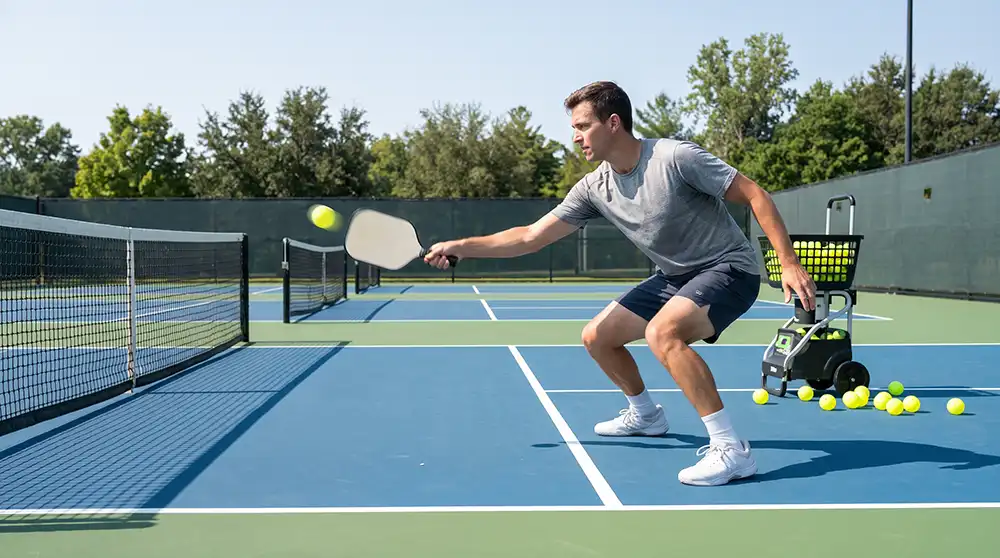
You do not need much to run these pickleball drills consistently. A bucket of 15 to 20 balls saves you from constantly chasing a single ball across the court, which is the single biggest time-waster in solo practice. A paddle you already trust matters more than any drill technique, since inconsistent equipment makes it hard to tell whether a missed shot was your technique or your gear.
A portable net or even sidewalk chalk marking the kitchen line works fine if you are practicing at a public court without permanent lines. For wall drills, any flat vertical surface at roughly net height works, a garage door or a school wall is common among players who practice solo.
Solo Drills (No Partner Needed)
These pickleball drills work against a wall or a backboard, so lack of a partner is not an excuse to skip practice.
Wall dinking. Stand about seven feet from a wall (roughly kitchen-line distance) and dink the ball against it continuously, aiming for soft, controlled contact rather than power. Twenty consecutive hits without the ball dying or flying past your control zone is a solid benchmark for a developing player.
Shadow footwork. Without a ball, practice the split-step and lateral shuffle you would use to cover the kitchen line. Most unforced errors at the net come from footwork arriving late, not from bad hands.
Serve target practice. Place a towel or cone in each back corner of the service box and aim for it on ten consecutive serves. Depth on your serve buys you time on the return, which matters more at the intermediate level than raw pace.
Dinking Drills for Kitchen Control
The kitchen is where rallies are actually won or lost, so these pickleball drills for dinking deserve more practice time than most players give them.
Cross-court dinking. With a partner, dink exclusively cross-court (the higher-percentage shot in real play) for ten-shot rallies before either player is allowed to attack. This builds patience and consistency under low pressure.
Straight-ahead dinking. Same idea, but down the line. This angle has less margin for error, so expect more mistakes early on. That is the point.
Dink and reset. One player hits progressively harder dinks while the other practices absorbing pace and resetting the ball softly back into the kitchen instead of popping it up. This single skill, resetting under pressure, separates recreational players from intermediate ones more than any other.
Third-Shot Drop Drills
The third shot drop is the shot most players avoid practicing because it is genuinely hard, which is exactly why it is worth isolated drill time.
Basket drops. From the baseline, drop a bucket of balls into the kitchen one at a time, focusing purely on arc and landing spot rather than pace. Aim for the ball to land soft enough that it cannot be attacked.
Serve, return, drop. With a partner, run the full sequence: serve, return, then the serving side attempts a third-shot drop. This adds the realistic pressure of transitioning from a deeper shot into a soft one, which is where the drop tends to break down in actual games.
Drop and advance. After a successful drop, immediately move up toward the kitchen line. Many players nail the drop technically but forget the follow-up footwork that gets them into net position.
Drills for Doubles Communication
Most doubles errors are not technical, they are communication gaps. These pickleball drills address that directly.
“Mine” and “yours” calling. During any rally drill, both partners must verbally call every ball as either theirs or their partner’s. This sounds basic and feels awkward at first, but it eliminates the mid-court collisions and hesitation that cost points in real matches.
Switch drill. Practice deliberately switching sides after a lob or a wide shot forces one partner out of position. Communication (“switching!”) should happen before the switch, not after.
Poach practice. One partner practices intentionally poaching (crossing over to take a shot that belongs to their partner) while calling it early enough for the partner to cover the vacated space.
How Often Should You Practice Drills?
Two to three focused pickleball drill sessions per week, fifteen to twenty minutes each, produces more improvement than one long weekly session. Drills build muscle memory through repetition spread over time, not through volume in a single sitting.
If you only have time for one drill category per session, rotate: dinking one day, third-shot drops the next, footwork or doubles communication the third. Consistency across skill areas beats mastering one shot while neglecting the others.
A Sample Weekly Drill Schedule
If you are not sure how to structure your own practice time, this three-day rotation covers every skill area without overloading any single session:
Day 1: Dinking focus (20 minutes). Ten minutes of wall dinking to warm up your hands, followed by ten minutes of cross-court and straight-ahead dinking with a partner if available, or continued wall work if solo.
Day 2: Third-shot drops and footwork (20 minutes). Ten minutes of basket drops from the baseline, followed by ten minutes of shadow footwork focused on the transition from baseline to kitchen line, the exact movement a real third-shot drop sequence demands.
Day 3: Serve accuracy and doubles communication (20 minutes). Ten minutes of serve target practice, followed by ten minutes of “mine or yours” calling drills if you have a regular partner, or additional dinking reps if you are practicing alone.
Three weeks of this rotation, roughly one hour of total drill time per week, is usually enough for a beginner or intermediate player to notice a real difference in kitchen consistency and shot selection during actual games.
If a week gets busy and you only manage one session, prioritize dinking. It has the highest carryover to actual match performance of any single drill category, since nearly every rally eventually reaches the kitchen line regardless of how the point started.
Pickleball Drills by Skill Level
Not every pickleball drill fits every skill level. Running advanced doubles communication drills before you can consistently dink ten balls in a row usually just builds frustration instead of skill.
Beginners (0 to 3 months): Focus almost entirely on wall dinking and serve target practice. These build the fundamental hand control and consistency that every other drill depends on. Skip the third-shot drop drills until dinking feels comfortable.
Intermediate (3 months to 2 years): This is where third-shot drop drills and the dink-and-reset drill matter most. Most intermediate players plateau specifically because they never isolated these two shots in practice, relying instead on picking them up gradually through match play.
Advanced players: Doubles communication drills and pattern-based drills, like serve-return-drop sequences run at game speed, offer the most value. At this level, technical execution is rarely the limiting factor, decision-making and partner coordination usually are.
Common Pickleball Drill Mistakes to Avoid
Drilling with poor habits just makes those habits more automatic, so avoid these common mistakes.
Practicing at full speed too soon. Slow the drill down until your technique is consistent, then add pace. Rushing to game speed before the fundamentals are automatic just reinforces sloppy form.
Skipping the boring drills. Wall dinking and shadow footwork are not exciting, so players skip straight to competitive-feeling drills. The unglamorous repetition is usually where the actual improvement happens.
No clear goal per session. “Practice for twenty minutes” is vague. “Hit 20 consecutive cross-court dinks without an error” gives you something concrete to measure and improve against session to session.
Never tracking progress. Even a simple note, like how many consecutive dinks you managed last week versus this week, keeps drilling purposeful instead of repetitive for its own sake.
Frequently Asked Questions
Common questions players ask about pickleball drills and practice routines.
Do I need a partner to practice pickleball drills?
No. Wall dinking, shadow footwork, and serve target practice are all effective solo drills. A partner helps with realistic pressure but is not required to improve.
How long does it take to see results from drills?
Most players notice a difference in kitchen consistency within two to three weeks of regular practice, roughly six to eight sessions, though third-shot drops typically take longer to feel natural.
What is the single most important drill for beginners?
Wall dinking. It isolates soft-hands control, which is the skill beginners lack most and the one that causes the most unforced errors at the net.
Can kids do these pickleball drills?
Yes, all of these scale down easily for younger players. Shorten the distances and use lighter, slower balls for kids still developing hand-eye coordination.
Should I drill before or after playing matches?
Before, when your legs and focus are fresh. Drilling after a long match session usually reinforces fatigue-driven bad habits rather than correcting technique.
What is the best pickleball drill for improving alone?
Wall dinking, since it is the only major drill category that fully replicates real dinking control without needing a partner or even a full court.
How many balls do I need for a solid drill session?
A bucket of 15 to 20 balls is enough for most solo drills and eliminates constant retrieval time, which otherwise eats into your actual practice reps.
