
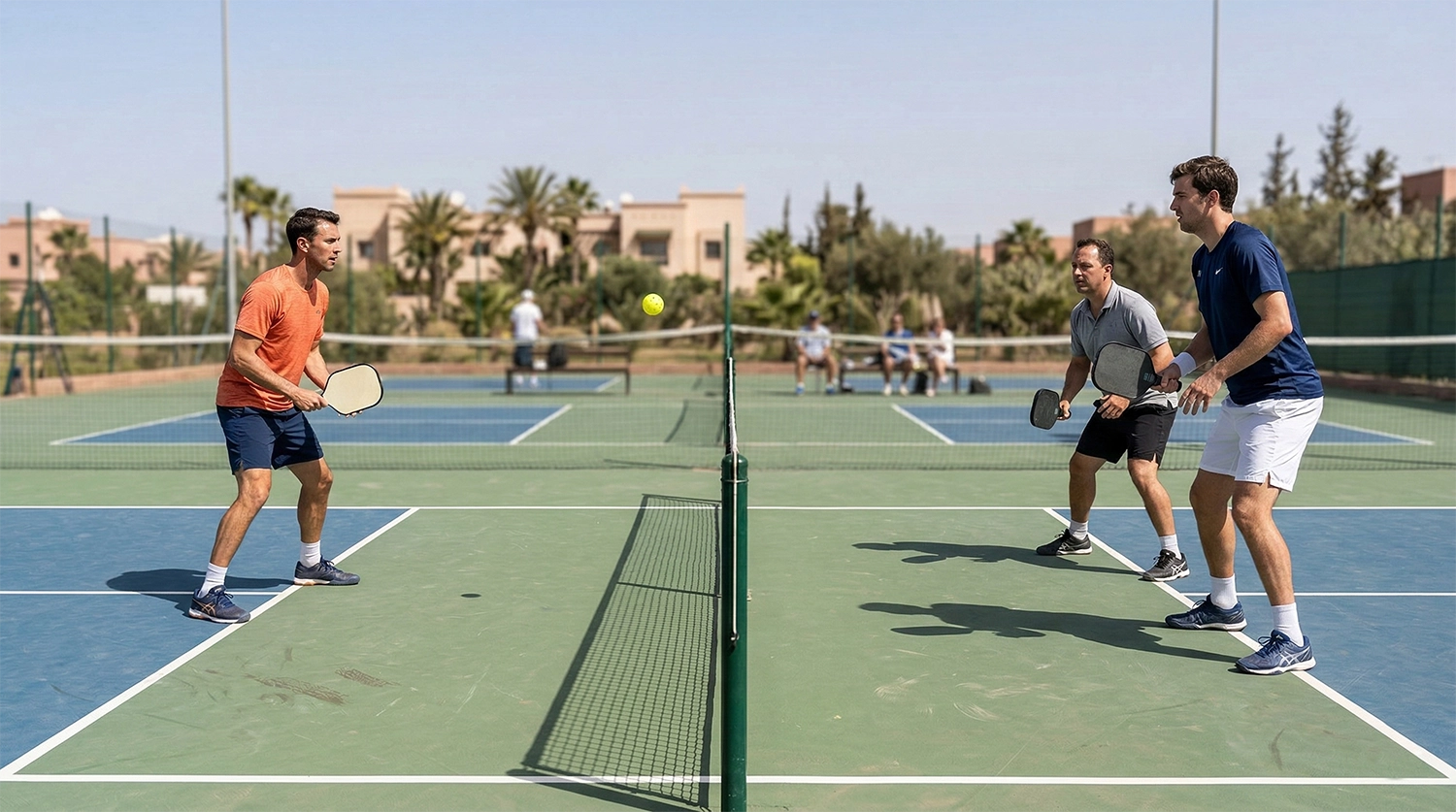
Pickleball Doubles vs Singles Rules: Complete Guide 2026
Pickleball doubles vs singles rules are so different that switching between formats feels like playing two completely different sports on the exact same court.
You cannot use the same tactics and expect to win. We need to look at the pickleball doubles vs singles rules to understand exactly why. Ready to level up your game? Let’s break down what changes when you drop your partner and go solo.
The Court Size and Setup
Let’s clear up the biggest misconception right now. The court dimensions are exactly the same for both formats. You play on a standard 20×44 foot area whether you have a partner or not.
This means a singles player has to cover a massive amount of ground alone. If you want to practice your solo mechanics without running miles, try Skinny Singles. You only use half the court, making it a fantastic drill to improve your accuracy.
Pickleball Doubles vs Singles Rules: The Key Differences
Understanding pickleball doubles vs singles rules starts with the serving system.
The biggest contrast lies in the differences in pickleball serving. In doubles, you use the two-server rule, meaning both you and your partner get a chance to serve before turning the ball over. In singles, you play by the single server rule.
If you lose the rally on your serve during a singles match, the ball immediately goes to your opponent. Scoring also looks entirely different. A doubles score requires three numbers: your score, their score, and the server number.
A singles score only uses two numbers: your score and their score.
For the complete official rulebook, visit USA Pickleball.
Strategy Shift: Power vs. Placement
The pickleball doubles vs singles rules don’t just affect scoring they completely change your strategy.
Your singles pickleball strategy revolves around baseline power, deep drives, and extreme speed. You want to pin your opponent back and force an error. You win by hitting aggressive passing shots.
Doubles requires a completely different approach. It is a game of extreme patience, strategic dinking at the kitchen line, and constant communication with your partner. You win by outlasting your opponents in soft volley exchanges, not by blasting the ball out of bounds.
Pickleball Doubles Rules The Complete Breakdown
Understanding pickleball doubles vs singles rules in depth starts with how doubles is actually structured from the first serve to the last point.
The Two-Server System
In doubles, each team gets two servers per rotation one per player. When your team wins the serve (called a Side Out), the player standing in the right service court serves first as Server 1. If Server 1 loses the rally, the serve passes to their partner as Server 2. Only when Server 2 loses the rally does the ball go to the opposing team.
This two-server system is what makes doubles scoring feel complex at first. The score is announced as three numbers your team’s score, the opponent’s score, and your server number (1 or 2). Example: “5-3-2” means your team has 5 points, opponents have 3, and you are the second server.
Positioning in Doubles
Positioning is where pickleball doubles vs singles rules diverge most dramatically in practice.
In doubles, both partners ideally want to reach the Kitchen line together as quickly as possible. The team that controls the Kitchen line wins the majority of points at every skill level. Moving to the Kitchen together, not one at a time is the single most important tactical principle in doubles play.
The stacking strategy is an advanced doubles tactic where both partners line up on the same side before the serve, then immediately reposition after the ball is struck. This keeps stronger players in their preferred positions regardless of which service box they’re technically supposed to occupy.
Communication in Doubles
Doubles pickleball is as much about communication as it is about skill. Calling “mine” or “yours” clearly on every ball prevents the most common doubles mistake two partners both going for the same ball, or worse, both leaving it for the other.
Establish these communication habits from your first game together:
- Call every ball that comes down the middle
- Announce “switching” when you cross to your partner’s side
- Call “out” immediately and loudly if the ball looks like it’s going long
- Poaching (crossing to hit your partner’s ball) should always be announced beforehand
Pickleball Singles Rules The Complete Breakdown
The Single-Server System
In singles, there is no partner and no Server 2. If you lose the rally on your serve, the ball goes immediately to your opponent. No second chances. This makes every serve more high-stakes than in doubles a single fault ends your scoring opportunity entirely.
The score in singles is only two numbers: your score followed by your opponent’s score. “6-4” means you have 6 points and they have 4. Simple and clean.
Positioning in Singles
Positioning rules in singles are absolute and non-negotiable. Your score dictates exactly where you serve from on every single point:
- Even score (0, 2, 4, 6, 8, 10): Serve from the right service court
- Odd score (1, 3, 5, 7, 9): Serve from the left service court
There are no exceptions. If you serve from the wrong side, it’s a fault. This rule keeps both players correctly positioned throughout the match without the complexity of the three-number doubles system.
Court Coverage in Singles
A singles player must cover the full 20 x 44-foot court alone. That’s 880 square feet of ground to defend against a focused opponent trying to exploit every open space.
The most effective singles strategy is to keep your opponent pinned deep at their baseline with consistent deep drives, then attack when they hit a short ball. Unlike doubles where patience and dinking dominate singles rewards aggressive groundstrokes and superior court coverage.
Skinny Singles The Best Drill for Both Formats
Skinny Singles is one of the most effective training tools in pickleball, and it directly improves your performance in both doubles and singles formats.
Instead of using the full 20-foot width, Skinny Singles restricts play to one half of the court either the two right service boxes or the two left service boxes. Both players stay on their designated half for the entire game.
Why it works:
- Forces precise placement there’s nowhere to hide with half the width
- Dramatically improves your crosscourt dink consistency
- Builds the accuracy and patience needed for Kitchen-line doubles battles
- Less running than full singles, making it accessible for all fitness levels
Play Skinny Singles crosscourt (diagonal boxes) to practice your dink game. Play it straight (same-side boxes) to practice your drive and reset game. Alternate between the two formats in a single practice session for maximum improvement.
Doubles vs Singles Which Format Should You Start With?
If you’re a brand new player, start with doubles without question. Here’s why:
More court coverage help: Your partner covers half the court, giving you time to learn positioning without being physically overwhelmed.
Slower pace: Four players on a small court naturally creates more dinking and less explosive sprinting. You’ll have more time to think between shots.
Social and forgiving: Mistakes are shared. A weak return from you can be covered by a strong partner. The social element also keeps your first sessions fun rather than stressful.
Better for learning the Kitchen game: The doubles format forces you to develop the dink and soft game that are the foundation of all advanced pickleball singles or doubles.
Once you’ve played 20-30 hours of doubles and feel comfortable at the Kitchen line, singles will accelerate your improvement dramatically. The solo court coverage and immediate serve consequences force you to eliminate weak shots from your game fast.
The Physical Demands and Footwork
Playing singles demands brutal cardiovascular endurance. You must execute fast lateral sprints to cover the entire court alone. It will redline your heart rate in minutes.
Doubles requires coordinated pendulum movement with your partner. You move together horizontally like you have a rope tied between your waists.
Do not wear your old running shoes for singles. You will roll an ankle making those aggressive lateral cuts.
Gear Adjustments (Paddle Choice)
A singles player often needs a heavyweight or power paddle to generate deep baseline drives. You need that extra pop to hit passing shots past a stranded opponent.
A doubles player needs a control paddle for rapid kitchen-line volley exchanges. You need soft touch to reset the ball and drop it perfectly into the non-volley zone.
FAQ
Is pickleball harder to play singles or doubles?
Singles is physically harder, doubles is tactically harder. Singles will push your cardio to the absolute limit, while doubles requires complex partner coordination and patience.
Do I need a different paddle for singles?
Yes, many players switch to a heavier power paddle for singles. You need that extra mass to drive the ball deep into the opponent’s baseline.
Master the Court and Dominate
You now know exactly how to adjust your game for both formats. Master the rules, grab the right gear, and hit the courts. Stop overthinking your next match and start executing these strategies.
Now get out there and practice. Your opponents will not know what hit them.
Now you understand the pickleball doubles vs singles rules adjust your game, grab the right gear,
and dominate both formats.
