
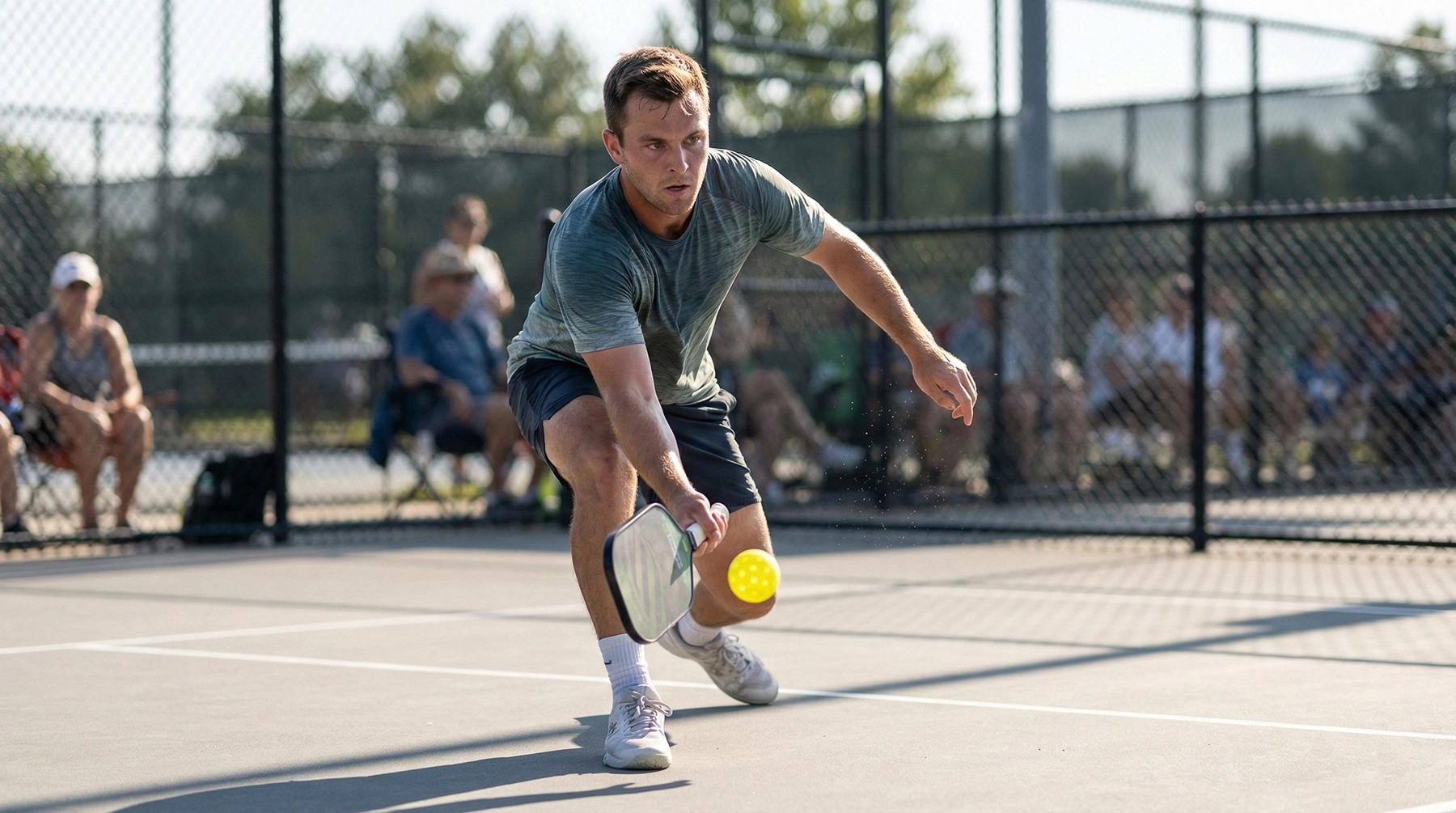
Pickleball Strategy Guide 2026
Why Most Beginners Lose (And How to Fix It)
Most beginners rely entirely on power instead of tactics, and that’s exactly why they keep losing.
Pickleball is physical chess, not a home run derby. Winning matches means outsmarting your opponents, not overpowering them. With millions of new players joining every year, competition keeps getting tougher. This guide breaks down the tactics that actually move you up the skill ladder this year.
Master the Kitchen (The Non-Volley Zone)
The Non-Volley Zone, better known as the Kitchen, dictates the entire flow of the game. This 7-foot area on both sides of the net is where matches are won and lost. You can step inside it anytime, but you can’t volley the ball while standing there.
A common trap for new players is smashing at the Kitchen line. That’s a mistake: from that distance, you’ll usually hit it out of bounds or pop it up for an easy put-away.
Instead, embrace dinking: a soft, controlled shot that arcs downward into your opponent’s Kitchen. Patience wins at the net. Keep dinking until your opponent makes the mistake.
[Best Control Paddles: Find Your Perfect Match]
The Third Shot Drop: The Golden Rule
If you take one technique from this guide, make it the third shot drop. It’s the single most important shot in the game, and it’s what lets you and your partner move safely from the baseline up to the Kitchen line.
The serving team is always at a disadvantage because the return team usually reaches the net first. A soft, looping third shot drop into their Kitchen forces them to hit upward, which neutralizes their attack and buys you time to close in.
Getting this shot right comes down to technique: keep your paddle head down and brush up on the back of the ball. That motion creates topspin, which pulls the ball down sharply over the net and keeps it low.
[Carbon Fiber vs. Fiberglass Paddles: Which is Better?]
Court Positioning and Footwork
Good footwork separates good players from everyone else. Stay balanced, stay low, and move efficiently. Most of your movement at the Kitchen line should be lateral, never backpedal.
In doubles, you and your partner move like a pendulum: when the ball goes wide left, you both shift left to cover the angles. Leave a gap between you, and a smart opponent will find it fast.
Your footwear matters more than most beginners think. Regular running shoes will hurt your game and your ankles. Get proper court shoes with real lateral support for sudden stops and direction changes.
[Best Pickleball Shoes: Protect Your Ankles]
Doubles vs. Singles Strategy
Singles and doubles feel like different sports, and your strategy needs to adapt accordingly:
| Strategy Focus | Singles Pickleball | Doubles Pickleball |
|---|---|---|
| Primary Goal | Exploit open court space | Control the Kitchen line |
| Shot Selection | Deep drives and passing shots | Soft dinks and third shot drops |
| Pacing | Fast and aggressive | Patient and methodical |
| Key Skill | Speed and baseline power | Partner communication and positioning |
Advanced Tactics: Take Your Game to the Next Level
Once you’ve got positioning and the third shot drop down, these tactics separate you from the average recreational player.
The Erne: Surprise Your Opponents
The Erne is one of the most unexpected shots in competitive pickleball. Instead of dinking cross-court from the Kitchen line, you jump around the Kitchen corner (landing outside the court boundary) and volley the ball at a sharp, undefendable angle.
Disguise is everything here. If your opponent spots you setting up, they’ll simply redirect the ball away from you. Start moving toward the corner as if you’re going to dink normally, then accelerate and jump at the last moment.
Stacking: Control Your Positioning
Stacking is a doubles strategy where both partners line up on the same side of the court before the serve, then reposition to their preferred sides right after the ball is struck.
Why bother? It keeps your stronger player in their dominant position regardless of the serving rotation. If your best forehand is on the left but rotation puts you on the right, stacking resets your position every point.
The Lob: Use It Sparingly
A well-timed lob pushes your opponents off the Kitchen line and resets the rally in your favor. Hit it when both opponents are leaning forward at the net: a high, deep lob over their heads forces them to retreat and buys you time to reposition.
The risk: a poorly hit lob sits up and invites a crushing overhead smash. Treat it as a surprise weapon, not a regular shot.
Speed Up: Break the Dink Rally
During a slow dinking exchange, a sudden speed-up can catch your opponent completely off guard. Instead of continuing the soft game, accelerate the ball sharply at your opponent’s shoulder or hip, the hardest area to defend.
Again, disguise matters most. Your paddle motion should look identical to a dink until the last fraction of a second. Telegraph it, and experienced players will read it and attack your response.
Pickleball Strategy by Skill Level
Your optimal strategy shifts as you improve. Here’s what to focus on at each stage:
Beginner (2.5–3.0)
At this level, consistency beats everything. Your only real goal is keeping the ball in play longer than your opponent.
- Focus on: getting the ball over the net consistently
- Avoid: trying to hit winners from the baseline
- Key habit: move toward the Kitchen line after every serve return
- Winning strategy: let your opponents make the mistakes they will
Intermediate (3.5–4.0)
You can keep rallies going and understand the basics. Now strategy starts to matter.
- Focus on: third shot drop execution
- Avoid: the banger mentality, start building your soft game
- Key habit: move as a unit with your doubles partner
- Winning strategy: control the Kitchen line and win the dink battle
Advanced (4.5+)
Everyone at this level can execute the basics. Winning comes down to tactics and composure.
- Focus on: speed-ups, Ernes, and stacking
- Avoid: predictable patterns, mix up your placement
- Key habit: study your opponent’s weaknesses and exploit them systematically
- Winning strategy: force uncomfortable positions and attack the weak spots
How to Find Your Rating
USA Pickleball uses a rating system from 1.0 (complete beginner) to 6.0+ (professional). Most recreational players sit between 2.5 and 4.0. Rating yourself honestly helps you find the right competition and the right things to practice.
Check our complete guide: Pickleball Skill Levels Explained
The Mental Game: The Overlooked Edge
Physical technique gets most of the attention, but the mental game is what separates good players from great ones.
Control your reaction time. After losing a point, most beginners rush into the next rally. Slow down, take a breath, reset. The best players carry the same demeanor whether they’re up 10-2 or down 2-10.
Play the percentages. Every shot carries a risk-reward tradeoff. A down-the-line passing shot in singles is high risk, high reward; a soft cross-court dink is low risk, low reward. Under pressure, take the shot you can execute 8 out of 10 times. Save the hero shots for when you’re comfortable and in control.
Target the weaker opponent. In doubles, figure out which opponent gets uncomfortable under pressure and direct more shots their way. It’s not unsportsmanlike, it’s just smart, and every level of competitive play does it.
Reset when you’re losing. If your current approach isn’t working, change it. Drives keep going out? Switch to drops. Dinks keep sitting up? Slow your swing down. Good players adjust mid-match instead of repeating a failing plan.
Stop Making These 3 Beginner Mistakes
1. The Banger Mentality
A banger hits every ball as hard as possible. It works against complete beginners and fails miserably against experienced players, who will simply block your fast drives back into the Kitchen. Stop chasing winners from the baseline and start playing the soft game.
2. Backpedaling Instead of Moving Laterally
Never run backward to chase a deep lob: it destroys your balance and invites falls. Turn your body sideways instead and use a cross-over step toward the baseline. It keeps you stable and lets you track the ball properly.
3. Using Cheap or Wrong Equipment
A cheap wooden paddle caps your progress fast. It lacks the grit for spin and the core materials for a soft touch. Invest in gear that actually matches where your game is heading.
[How to Choose a Pickleball Paddle: Complete Buying Guide]
FAQ
How do I beat a banger?
Hold your ground at the Kitchen line and keep your paddle out in front of you. Soft block volleys drop their fast drives right back into their own Kitchen. They’ll get frustrated eventually and hit it into the net or out of bounds.
Where should I stand when receiving the serve?
Two to three feet behind the baseline. Serves often kick deep and bounce high near the back, so standing further back gives you time to step forward into a strong, deep return.
When should I drive the third shot instead of dropping it?
Drive it if the return of serve lands short and bounces high: that gives you an aggressive angle. Follow up with a soft fifth shot drop if they manage to block your attack.
For official rules and tournament info, visit USA Pickleball
Your Strategy Starts Now
You’ve got the playbook and you know the tactics. Reading about strategy only gets you so far. The rest happens on the court.
Kitchen mastery, the third shot drop, court positioning, and the three mistakes to cut out immediately: that’s everything you need. Grab your paddle, call your partner, and head to the courts. Drill these until they’re second nature.
Now get out there and start winning.
