
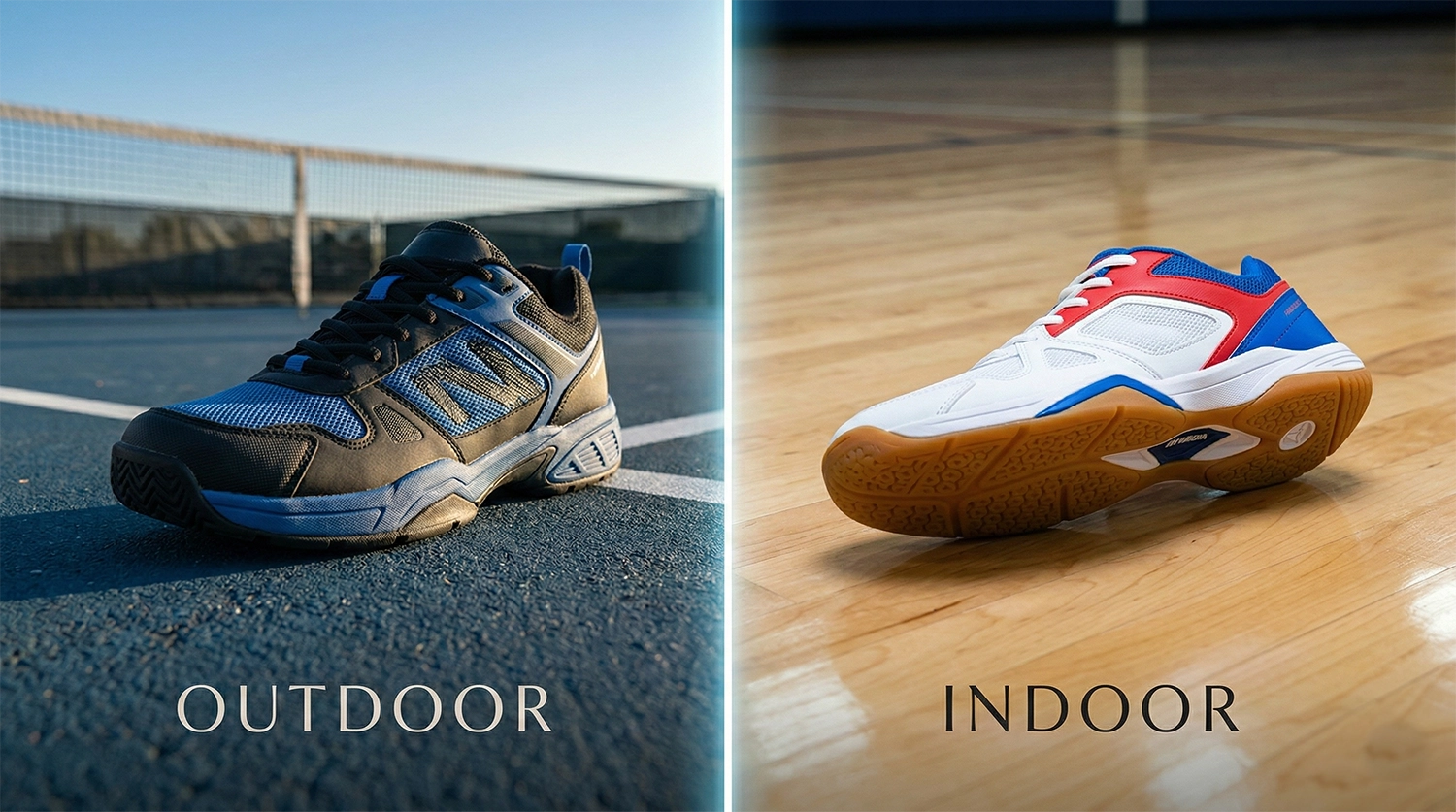
Indoor vs Outdoor Pickleball Shoes: Which Should You Choose?
Indoor vs Outdoor Pickleball Shoes: The Differences That Protect Your Ankles
The indoor vs outdoor pickleball shoes decision is not a preference question — it is a safety question. Wearing the wrong shoe on the wrong surface does not just hurt your game. It puts your ankles, knees, and lower back at serious risk every time you make a lateral cut.
This guide breaks down exactly what separates indoor from outdoor pickleball shoes, why cross-using them is a mistake most players regret, and how to choose the right pair for every surface you play on. Before we get into the breakdown, one non-negotiable rule applies to both categories: never play pickleball in running shoes. Running shoes are designed for forward motion. Pickleball is 80% explosive lateral movement. A running shoe on a pickleball court is a rolled ankle waiting to happen.
Indoor vs Outdoor Pickleball Shoes — The Core Difference
The single most important difference between indoor and outdoor pickleball shoes is the outsole material. Everything else — weight, flexibility, toe protection — follows from this one decision.
Outdoor courts are asphalt or concrete coated with acrylic and embedded with sand. The surface is abrasive, grippy, and unforgiving on soft materials.
Indoor courts are polished wooden gym floors or synthetic rubberized surfaces. The surface is smooth, slick, and collects dust — creating a completely different traction challenge.
An outsole engineered for one surface will fail on the other. This is not an opinion — it is basic materials physics.
The Anatomy of an Outdoor Pickleball Shoe
Outdoor pickleball shoes are built like armored tanks because outdoor courts demand it.
Hard rubber outsole with herringbone tread. The outsole is high-density rubber designed to survive the constant friction of concrete without wearing flat. The herringbone (zigzag) tread pattern grips the gritty surface on lateral cuts while providing just enough controlled give to prevent ankle snap-back when you stop suddenly.
Reinforced toe drag guard Pickleball players drag their toes — on serves, on lunges, on recovery steps. On outdoor courts, standard shoe materials disintegrate within days under this friction. Quality outdoor shoes feature a reinforced toe drag guard made of thick polyurethane or Kevlar-blended material that prevents premature blowouts.
Heavier construction for joint stability. Outdoor shoes are designed to carry more material. The added weight provides greater lateral stability on hard pavement, where the consequence of insufficient ankle support is immediate and painful.
Key features of outdoor pickleball shoes:
- High-density rubber outsoles engineered for concrete
- Deep herringbone tread for grit-grip
- Reinforced toe drag protection
- Heavier and stiffer for maximum joint stability on hard surfaces
👉 Ready to buy? See our tested picks: Best Men’s Pickleball Shoes 2026 and Best Women’s Pickleball Shoes 2026
The Anatomy of an Indoor Pickleball Shoe
Indoor pickleball shoes solve a completely different problem: how to grip a smooth, slick surface that accumulates dust and offers zero natural friction.
Soft gum rubber outsole. If you wear hard outdoor rubber on a wooden gym floor, you will slide. Indoor pickleball shoes use a softer, stickier rubber — commonly called a gum sole — that physically grips the wood surface like a squeegee on glass. Without this specific rubber compound, hard lateral cuts on indoor surfaces become genuinely dangerous.
Non-marking sole. Every gym has the same rule: non-marking shoes only. Indoor pickleball shoes use rubber compounds that grip without leaving black scuff marks on the floor. This is not optional — most gyms will remove you from the court for wearing marking soles.
Lighter and more flexible construction. Because indoor shoes do not need to be armored against concrete abrasion, they are built lighter and more flexible than outdoor shoes. This translates into faster footwork and better natural court feel on smooth surfaces.
Key features of indoor pickleball shoes:
- Soft, sticky gum rubber outsoles
- Lighter and highly flexible upper materials
- Non-marking soles (mandatory for most gyms)
- Less toe-drag armor required
The Dangerous Myth of Cross-Compatibility
The most common question beginners ask about indoor vs outdoor pickleball shoes is: “Can I just buy one pair for both?”
Technically yes. Functionally, it is a mistake with real consequences.
Wearing indoor shoes outdoors: The soft gum rubber outsole is not engineered for concrete abrasion. Outdoor courts will destroy the sole within three to four weeks of regular play. The softer lateral support also puts your ankles at greater risk on hard pavement than a proper outdoor shoe.
Wearing outdoor shoes indoors: Hard, dense rubber cannot grip smooth wood. Dust accumulates on the rigid outsole and creates a lubricated layer between shoe and the floor — turning your footwear into literal ice skates. Players who try outdoor shoes on indoor courts consistently report slipping on lateral cuts that they make safely in the correct footwear.
The financial math also favors two pairs: a proper outdoor shoe lasts six months of aggressive outdoor play; an indoor gum sole lasts equally long when used only indoors. Cross-using either destroys the outsole in weeks.
Indoor vs Outdoor Pickleball Shoes — Side-by-Side Comparison
| Feature | Outdoor Shoes | Indoor Shoes |
|---|---|---|
| Outsole Material | Hard, dense rubber | Soft gum rubber |
| Tread Pattern | Deep herringbone | Flat or shallow |
| Toe Protection | Reinforced drag guard | Minimal |
| Weight | Heavier | Lighter |
| Flexibility | Stiffer | More flexible |
| Non-Marking | Not required | Mandatory |
| Best Surface | Asphalt, concrete | Wood, synthetic gym |
What Happens If You Use Running Shoes?
Running shoes have a high heel drop and thick, cushioned midsoles designed for forward momentum over long distances. They have zero lateral support. When you lunge sideways for a dink in running shoes, your foot slides over the edge of the sole — creating the exact mechanics that cause rolled ankles. According to the USA Pickleball Association, court-specific footwear is the single most preventable equipment factor in pickleball injury. Never wear running shoes for racket sports.
How Long Do Pickleball Shoes Last?
Outdoor shoes: With aggressive play three to four times per week, expect your outdoor shoes to last three to six months before the herringbone tread wears flat. Once the tread pattern is gone, the shoe is unsafe for lateral movement regardless of how intact the upper looks.
Indoor shoes: Indoor gum soles last significantly longer when used only on indoor surfaces — typically eight to twelve months with regular play — because wooden floors are far less abrasive than concrete.
The break-even point for buying two pairs versus one pair is approximately two months of regular mixed-surface play.
FAQ — Indoor vs Outdoor Pickleball Shoes
Can I use volleyball shoes for indoor pickleball? Yes. High-end volleyball shoes are designed for the exact same slick wooden floors and explosive lateral movements as indoor pickleball. They feature the sticky gum rubber outsoles you need and are a legitimate alternative to dedicated indoor pickleball shoes.
What is the best indoor vs outdoor pickleball shoe for wide feet? Wide-fit options are available in both categories. See our breakdown: Best Pickleball Shoes for Wide Feet 2026
Do I really need two separate pairs? If you play exclusively on one surface, no. If you play on both indoor and outdoor courts regularly, two pairs will cost you less over twelve months than replacing one cross-used pair every six to eight weeks.
How do I know if my current shoes are court shoes? Turn the shoe over. If the outsole is white or gum-colored with a flat or shallow tread, it is an indoor shoe. If the outsole is black or dark with a deep herringbone tread, it is an outdoor shoe. If it has a thick, cushioned midsole with a heel raise, it is a running shoe — do not use it on a pickleball court.
The Bottom Line: Match the Shoe to the Surface
The indoor vs outdoor pickleball shoes decision comes down to one principle: match the outsole material to the surface you are playing on. Hard rubber for outdoor concrete. Soft gum rubber for indoor wood. Anything else is a compromise that costs you either money, performance, or physical safety.
If you play exclusively outside, invest in a durable outdoor court shoe with a reinforced toe guard. If you play in a gym, buy a dedicated non-marking gum sole shoe. If you play both, budget for two pairs — it is the only approach that protects both your body and your equipment investment.
Your ankles absorb every lateral cut you make. Treat your footwear as the protective equipment it is.
