
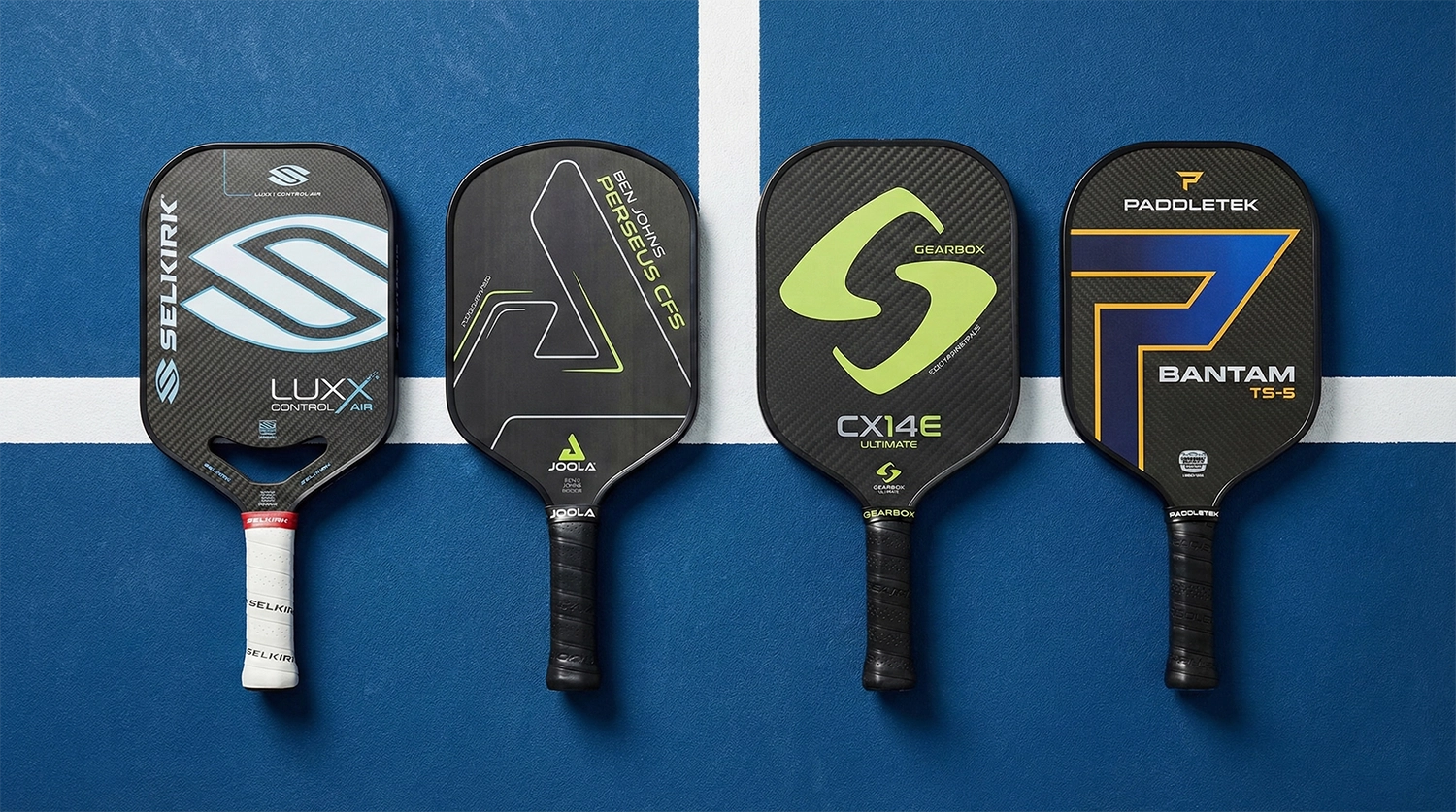
Pickleball Paddle Buying Guide 2026: Best Ultimate Guide to Choose Your Weapon
This pickleball paddle buying guide 2026 will help you make the most important equipment decision you will ever make as a player. A paddle won’t fix a bad swing, but the wrong paddle will absolutely ruin a good game.
If you’ve spent more than five minutes Googling “best pickleball paddles,” you are probably already suffering from analysis paralysis. Buzzwords like “thermoformed,” “raw carbon fiber,” and “swing weight” are everywhere. Prices range from $30 wooden toys to $300 professional weapons.
This pickleball paddle buying guide 2026 cuts through the marketing hype to help you find your perfect match. Choosing a paddle is a mathematical equation combining weight, core thickness, and surface material — and this guide breaks down every variable simply.
If you already know your specs and just want to see the elite tier of the market, jump straight to our master list of [The Best Pickleball Paddles in 2026], or compare the top manufacturers in our breakdown of [The Best Pickleball Paddle Brands in 2026].
Pickleball Paddle Buying Guide 2026 — Rule 1: Core Thickness (The Millimeter Debate)
The core is the engine of your paddle. Almost all modern paddles use a polymer honeycomb core, but the thickness dictates how the paddle behaves entirely.
16mm (Thick Core) = Control & Plush Feel
Thicker cores absorb more energy from the ball. When a 40mph drive comes at you, a 16mm paddle acts like a shock absorber — slowing the ball down and allowing you to drop it softly into the kitchen.
Struggling with popping the ball up too high? A thicker core will fix that. Check out our top picks for [Best Pickleball Paddles for Control in 2026].
13mm to 14mm (Thin Core) = Power & Pop
Thinner cores do not absorb energy — they reflect it. The ball spends less time on the paddle face and violently pops off the surface. This is strictly for advanced players who already have established control and want to hit aggressive, high-speed put-aways.
For official paddle specifications and approved equipment, visit USA Pickleball.
Rule 2: Face Material (Friction vs. Speed)
What wraps around the core dictates your spin potential and the “crispness” of your shots. This is the second most important variable in any pickleball paddle buying guide 2026.
Fiberglass (Composite)
Fiberglass is highly flexible. When the ball hits a fiberglass face, the material bends slightly and acts like a trampoline — shooting the ball back with extra speed. It offers great “pop” but less natural spin.
Fiberglass is highly cost-effective. If you want great performance without emptying your wallet, see our guide to the [Best Pickleball Paddles Under $100 in 2026].
Carbon Fiber & Raw Carbon
Carbon fiber is incredibly stiff. It doesn’t provide the trampoline effect, meaning you have to supply your own power. However, “Raw Carbon Fiber” features a highly textured, gritty surface that grips the plastic ball like sandpaper — perfect for heavy topspin and nasty slice returns.
Want to hit heavy topspin drives? Explore our strictly tested list of the [Best Pickleball Paddles for Spin in 2026].
Rule 3: Weight and Aerodynamics
Do not ignore paddle weight. Playing with the wrong weight will either slow down your reaction time or physically injure your arm. This is one of the most overlooked sections in any pickleball paddle buying guide 2026.
Lightweight Paddles (Under 7.8 oz)
Lighter paddles allow for lightning-fast hand speed during fire-fights at the net. More importantly, they reduce the strain on your elbow and shoulder.
Protect your joints and speed up your hands at the kitchen line by choosing from the [Best Lightweight Pickleball Paddles in 2026].
Mid-Weight Paddles (7.8 oz – 8.2 oz)
This is the sweet spot for 80% of players. It offers enough mass to block hard shots stably, but is light enough to keep your hands fast. If you are unsure where to start, start here.
Heavyweight Paddles (Above 8.2 oz)
Heavy paddles deliver crushing power because the mass does the work for you. However, they cause severe fatigue and are the leading equipment-related cause of tennis elbow in amateur players.
Rule 4: Shape and Handle Length
The physical dimensions of your paddle change where the “sweet spot” is located.
Standard / Widebody: The largest, most forgiving sweet spot. If you mis-hit the ball near the edge, it will still go over the net — perfect for beginners.
Elongated: Longer and narrower. They provide extra reach and a higher “swing weight” for more power, but the sweet spot is smaller. Best for experienced players.
Handle Length: If you hit a two-handed backhand, you must look for an elongated handle (5.3 inches or longer) to comfortably fit your second hand.
Pickleball Paddle Buying Guide 2026: Make Your Final Choice
Now you have everything you need from this pickleball paddle buying guide 2026 — based on science, not marketing hype.
- Extreme spin? Invest in a Raw Carbon Fiber face.
- Arm pain? Drop your paddle weight below 7.8 oz immediately.
- Just starting out? Look for a 16mm thick core and a standard widebody shape for maximum forgiveness.
Don’t overcomplicate your first purchase — start with our dedicated guide to the [Best Pickleball Paddles for Beginners].
Your paddle is an extension of your arm. This pickleball paddle buying guide 2026 gives you everything you need to stop wasting money on marketing hype and invest in a weapon that actually elevates your game.