
The Ultimate Pickleball Gear Checklist for Beginners (2026): What You Actually Need
Introduction Walk onto any pickleball court and you’ll see it: players with $300 paddles, massive designer bags, and matching tournament outfits. It’s intimidating. You start wondering if you need to drop serious cash just to get started.
Here’s the truth: you don’t.
But you do need the right basics. Not to look the part, but to protect your body and actually enjoy the game. Too many beginners walk onto the court with the wrong gear—wooden paddles that wreck their elbows, running shoes that invite severe ankle injuries, and balls that don’t match their playing surface.
This guide cuts through the noise. We’ll cover the essential pickleball equipment you actually need to start playing today, why each piece matters, and—just as importantly—what you can skip until you’re ready to level up.
1. The Weapon: Your First Pickleball Paddle
Let’s start with the most important decision: your paddle.
Why Wooden Paddles Are a Mistake You’ll see wooden paddles marketed as “beginner-friendly” simply because they’re cheap. Ignore them completely. Wooden paddles are incredibly heavy. That extra weight forces your arm to work harder with every swing, putting unnecessary strain on your elbow. For many beginners, this leads straight to “tennis elbow”—a painful joint condition that can sideline you for months.
What to Look for Instead Your first paddle should have two key features: a polymer honeycomb core and a fiberglass or carbon fiber face. Polymer cores are the industry standard because they absorb shock and reduce vibration. Fiberglass faces provide a “pop” that helps you get the ball over the net without swinging too hard, while carbon fiber provides maximum spin.
👉 (Don’t want to spend $200 on your first paddle? You don’t have to. Check out our strictly tested guide to the [Best Pickleball Paddles Under $100 in 2026] to find high-quality, affordable options).
2. The Armor: Proper Court Shoes (Non-Negotiable)
This is where beginners make their biggest—and most dangerous—mistake.
Never Wear Running Shoes on a Pickleball Court Running shoes are designed strictly for forward motion. They have high, cushioned heels and squishy soles that work beautifully when you’re jogging in a straight line. But pickleball requires you to move side-to-side, stop suddenly, and pivot.
Running shoes offer absolutely zero lateral (side-to-side) support. When you lunge for a ball in running shoes, the soft edge compresses, and your ankle rolls over it. The result? Torn ligaments and trips to the emergency room.
What Makes Court Shoes Different Court shoes are built with a low center of gravity and flat, stiff outsoles specifically designed for lateral stability. They keep your foot locked onto the platform during aggressive side-to-side movements.
👉 (Protect your joints before you step on the court. Read our comprehensive breakdowns of the [Best Men’s Pickleball Shoes] and the [Best Women’s Pickleball Shoes] for our top safety recommendations).
3. The Ammunition: Indoor vs. Outdoor Balls
Here’s something that surprises most beginners: not all pickleballs are created equal. You cannot mix them up.
- Outdoor Balls: These are built to survive the elements. They are made from harder, heavier plastic with smaller holes (typically 40 holes). The extra weight and small holes help the ball cut through the wind, and the hard plastic survives the friction of rough asphalt courts.
- Indoor Balls: These are made from softer, lighter plastic with larger holes (typically 26 holes). Indoor courts have no wind, so the larger holes create a slower, more controlled game. The softer plastic also performs better on smooth wooden gym floors and produces less noise.
If you use an indoor ball outdoors, the wind will toss it around like a balloon, and the concrete will crack it in minutes. If you use an outdoor ball indoors, it will skip aggressively off the wood floor like a heavy rock. Always buy the ball that matches your court.
4. The Shield: A Proper Pickleball Bag
Think you can toss your new paddle into your regular gym bag with your keys and water bottle? Think again.
Modern pickleball paddles have highly textured surfaces designed to grip the ball and generate spin. That texture (often called “grit”) is incredibly delicate. If you throw your paddle into a backpack with hard objects, your keys and zippers will act like sandpaper, scratching the grit completely off within weeks. Once the grit is gone, your paddle is dead.
You don’t need a massive $150 tournament backpack. You just need a basic pickleball bag with a dedicated, padded paddle compartment that ensures your paddle never touches anything harder than soft fabric.
5. The Traps: What You DON’T Need Yet
Here is where we save you money. Walk into any pro shop and they will try to sell you these items. Say no.
- Lead Tape: Advanced players use lead tape to change the swing-weight of their paddles. As a beginner, adding weight will only ruin your mechanics and potentially injure your wrist.
- Expensive Overgrips: Your paddle comes with a factory grip. Use it until it wears out. You do not need specialized moisture-wicking overgrips until you start playing intense, sweaty tournaments.
- Professional Tournament Apparel: You do not need $80 moisture-wicking polos. Wear comfortable athletic shorts, a breathable t-shirt, and your court shoes. That is it.
Conclusion: Start Smart, Upgrade Later
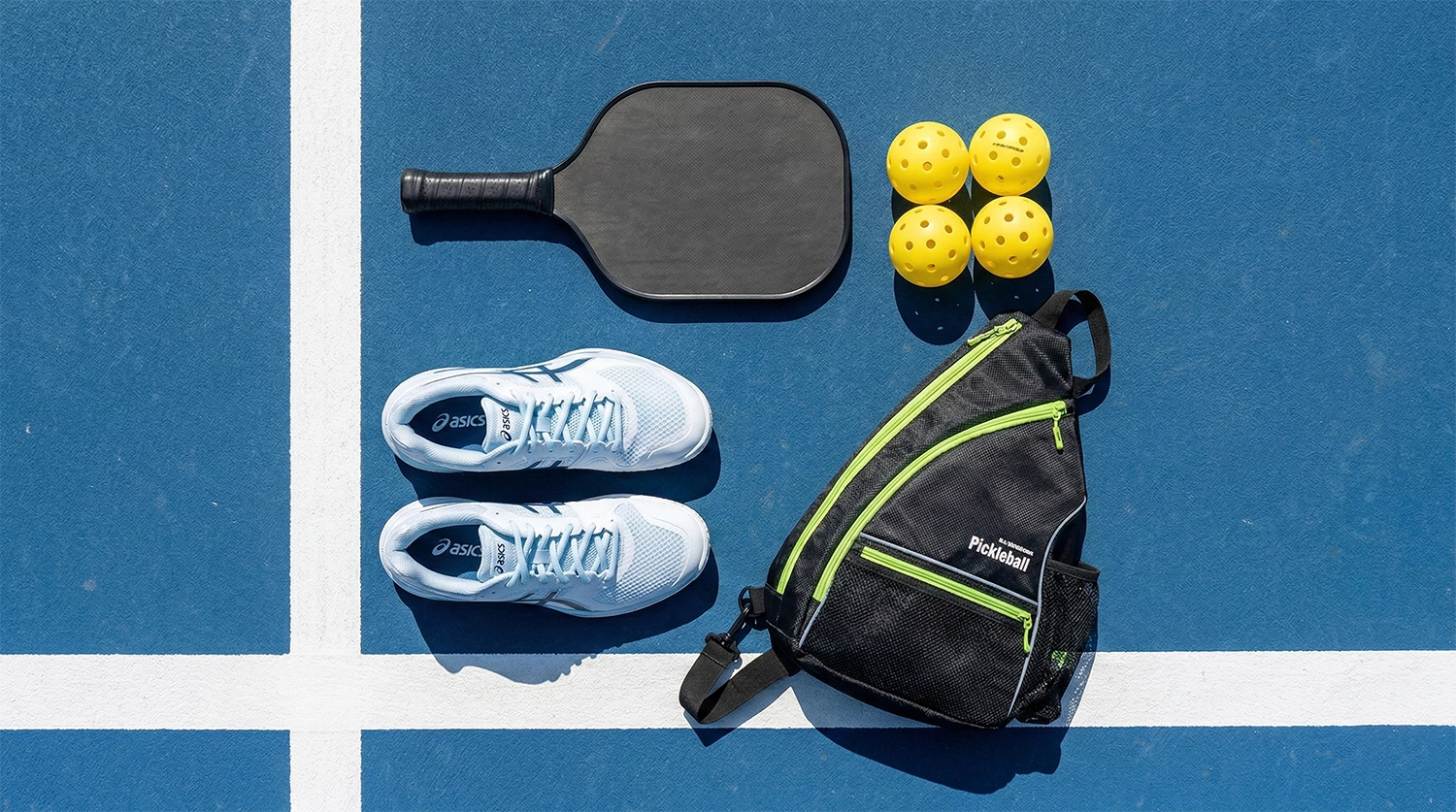
Here is your complete, distraction-free beginner shopping list:
- One paddle with a polymer core (avoid wood!). (Not sure how to pick one? Read our [Ultimate Guide to Choosing a Pickleball Paddle]).
- A pair of dedicated court shoes with lateral support.
- A 3-pack of USA Pickleball-approved balls (indoor or outdoor).
- A basic sling bag to protect your paddle’s grit.
This setup will get you on the court safely and efficiently. As you improve over the next few months, you will naturally start to notice what you want to change about your game. That is when you upgrade—when you actually know why you are upgrading.
Protect your ankles with the right shoes, protect your elbow with the right paddle, and get out on the courts!