
Introduction Your paddle shouldn’t twist in your hand. Your elbow shouldn’t ache after a few games. And you definitely shouldn’t be white-knuckling your grip just to keep the ball in play.
If any of these sound familiar, there’s a 90% chance your grip size is wrong.
Here is the medical truth: grip size isn’t just about comfort. It directly affects your power, your control, and your injury risk. Research shows that playing with the wrong grip size is the #1 cause of lateral epicondylitis—better known as “tennis elbow.”
Finding the exact right pickleball paddle grip size takes about 60 seconds. You don’t need fancy equipment; you just need your hand, a ruler, and this guide. Let’s get your grip dialed in so you can play pain-free. (If you are still looking for your first paddle, make sure you read our [ Essential Pickleball Gear Checklist for Beginners] first).
The Anatomy of Pickleball Grip Sizes
Before we measure, you need to understand the sizing scale. Grip sizes are measured in circumference (the distance around the handle). Most adult paddles range from 4.0 inches to 4.5 inches.
- 4.0″ (Small): Often preferred by women, youth players, or players wanting maximum wrist snap.
- 4.125″ (Small-Medium): A popular choice for players transitioning from tennis.
- 4.25″ (Medium): The standard industry size for most adult men and women.
- 4.375″ to 4.5″ (Large): Built for players with exceptionally large hands.
Why does 1/8 of an inch matter? Because your hand geometry is highly sensitive. A grip that’s slightly too small makes your tendons work overtime. A grip that’s slightly too large locks your wrist.
Method 1: The Index Finger Test (The Gold Standard)
This is the fastest, most practical way to check if a paddle fits your hand perfectly.
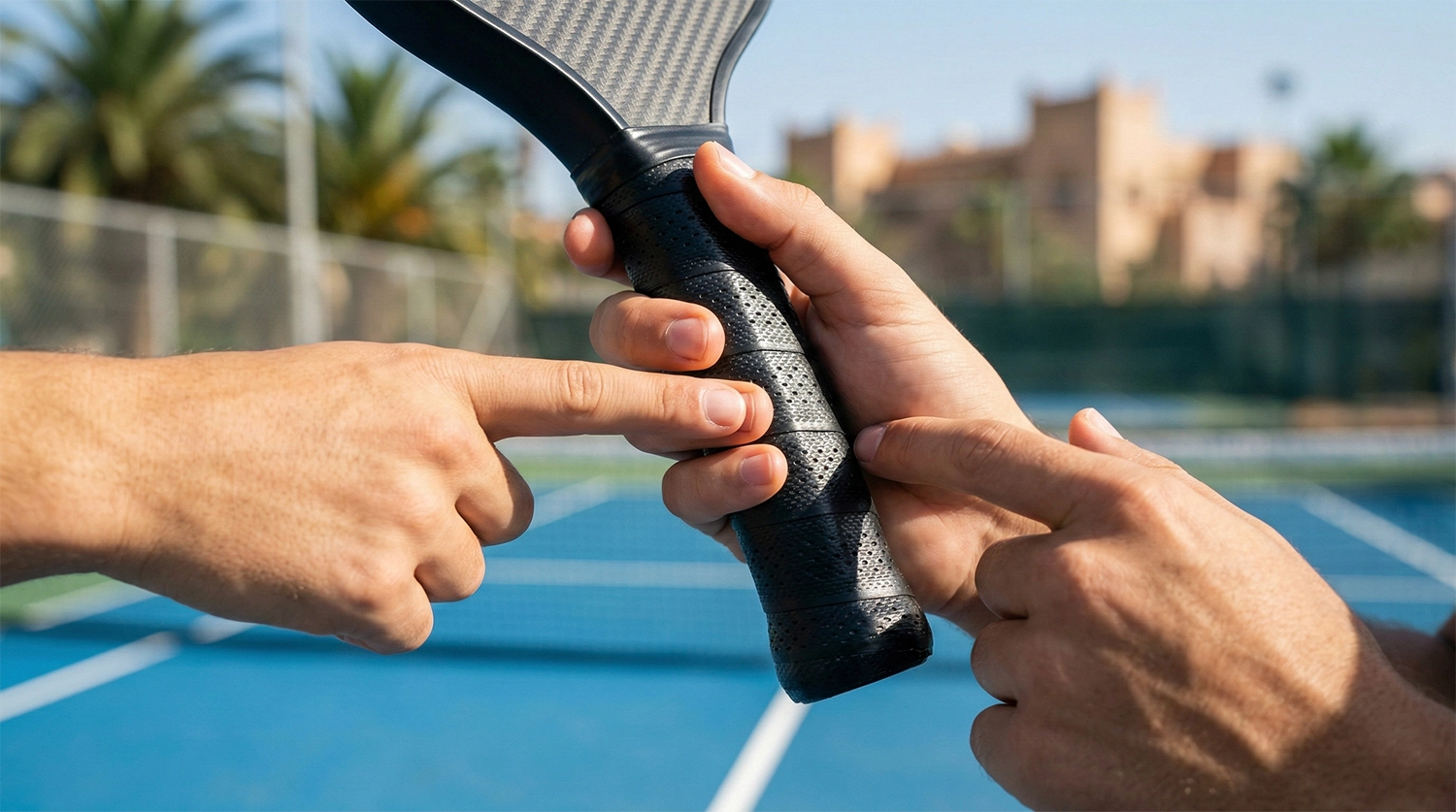
- Grab the paddle: Hold it with your dominant hand using a natural “handshake” grip (Eastern grip). Don’t squeeze tightly; just hold it as if you are waiting for a serve.
- Slide the finger: Take the index finger of your other hand and slide it into the gap between your fingertips and the base of your palm on the hand holding the paddle.
- Check the fit:
- Perfect fit: Your index finger fits snugly in the gap. It touches both your palm and your fingertips without forcing it.
- Too small: There is no room for your index finger to fit. Your fingers are wrapping all the way back into your palm.
- Too large: Your index finger slides in easily, and there is still extra empty space left over.
Method 2: The Ruler Test (The Scientific Method)
If you are buying a paddle online and don’t have one to test, you must use a ruler to measure your exact hand anatomy.
- Open your dominant hand completely flat, with your fingers extended and close together.
- Look at your palm. You will see two to three prominent horizontal creases running across the center.
- Place a ruler at the bottom horizontal crease (the lowest one in the middle of your palm).
- Measure straight up to the tip of your ring finger.
- That measurement in inches is your exact grip size. (For example, if you measure 4.2 inches, you should buy a 4.25″ grip).
Method 3: Measuring by Player Height
This is the least accurate method, but it works as a general baseline if you are buying a gift or cannot measure properly.
- Under 5’3″: Start with a 4.0″ grip.
- 5’3″ to 5’8″: Start with a 4.125″ to 4.25″ grip.
- Over 5’8″: Start with a 4.375″ to 4.5″ grip.
The Dangers of the Wrong Grip Size
Let’s be clear about what happens when you play with the wrong size. It actively damages your body.
Too Small: The Elbow Killer When your grip is too small, your fingers wrap too far around the handle. Because the paddle feels unstable, you instinctively squeeze harder. Your forearm muscles work overtime, and your wrist extensor tendons bear excessive load. Repetitive stress leads to severe inflammation (tennis elbow). (Struggling with a heavy paddle and a bad grip? You need to reduce the strain immediately. Check out our guide to the [Best Lightweight Pickleball Paddles in 2026]).+1
Too Large: The Control Thief When your grip is too large, your fingers cannot wrap far enough around the handle to secure it. You lose fine motor control. You will struggle to execute drop shots, and because your wrist is locked in a wide position, you lose the ability to generate aggressive topspin.
The Golden Rule: When in Doubt, Go Smaller
Here is the single most important rule in pickleball gear: If you are stuck between two sizes, always choose the smaller grip.
Why? Because you can easily build up a smaller grip, but you cannot shrink a larger grip.
If you buy a 4.0″ grip and it feels too small, you can buy a pack of “overgrips” for $5. Wrapping a single layer of overgrip around your paddle handle adds approximately 1/16 of an inch. You can layer 2 or 3 overgrips until the paddle fits your hand with mathematical perfection.
However, if you buy a 4.5″ grip and it is too large, you are stuck. You cannot shave down the handle’s polymer core without destroying the paddle and voiding your warranty. (Looking for paddles that offer multiple grip options out of the box? Browse our top picks for the [Best Pickleball Paddles Under $100]).
Take 60 seconds right now to measure your hand. Buy the right size, or go smaller and customize it. Your elbow will thank you.