
Introduction Are you consistently popping the ball up during dinks? Are your drives crashing into the net? Before you blame your swing or hire a coach, take a look at your paddle.
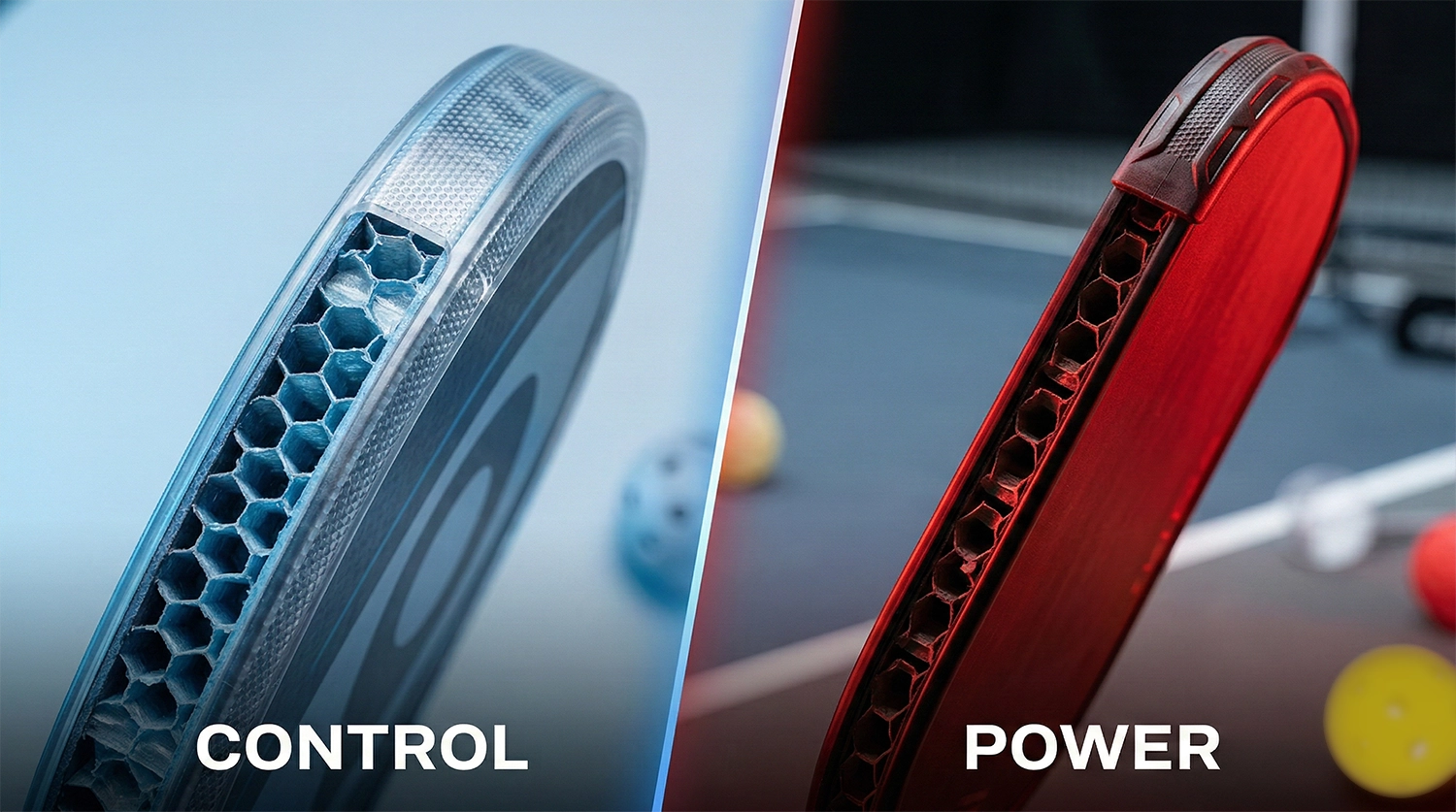
The biggest mistake beginners make is grabbing any paddle off the shelf without understanding one critical piece of engineering: core thickness. A 16mm paddle plays completely differently than a 13mm paddle. One absorbs energy like a shock absorber; the other reflects it back like a trampoline.
This isn’t marketing hype. It’s physics. Understanding the difference between “Power” and “Control” is the single most important decision you will make when buying gear. Let’s break down exactly what you need.
What Makes a Control Paddle? (The 16mm Core)
A control paddle uses a thick polymer core—typically 16mm (and sometimes up to 20mm).
Here is what happens when the ball hits a thick core: the extra material compresses and absorbs the ball’s kinetic energy. Think of it like dropping a ball onto a soft mattress versus a hardwood floor. The mattress (thick core) cushions the impact.
This energy absorption creates “dwell time”—the split second the ball stays physically compressed against the paddle face. More dwell time means you have more control over the ball’s trajectory.
Control paddles excel at:
- Dinking rallies: The core dampens the ball’s pace, making it easy to drop shots softly into the kitchen without popping them up for your opponent to smash.
- Resets and blocks: When your opponent drives a 40mph shot at you, a 16mm paddle absorbs that violent pace so you can reset the point.
- Injury Prevention: They absorb the shock that would otherwise travel up your arm, saving you from tennis elbow.
👉 (You don’t need to spend $250 to get a great control paddle. Many forgiving 16mm options are featured in our guide to the [ Best Pickleball Paddles Under $100 in 2026]).
What Makes a Power Paddle? (The 13mm/14mm Core)
Power paddles go thin—usually 13mm, 14mm, or sometimes lower.
When the ball hits a thin core, there is less material to compress. The paddle face stays incredibly stiff, and that stiffness reflects the ball’s energy right back instantly. You get immediate “pop”—that satisfying feeling when the ball rockets off your paddle with minimal physical effort on your part.
The trade-off? Less forgiveness. Thin cores reduce dwell time and have a noticeably smaller sweet spot. Miss the dead-center of the paddle, and the ball will die.
Power paddles excel at:
- Aggressive Drives: That extra pop helps you blast balls past opponents at the baseline.
- Generating pace: If you lack natural upper body strength, a power paddle does the mechanical work for you.
- Singles play: Singles requires massive court coverage and aggressive passing shots where velocity is king.
👉 (Power paddles with thinner cores also tend to weigh less. If you want maximum hand speed at the net, pair a thin core with one of our top picks for the [Best Lightweight Pickleball Paddles in 2026]).
The Face Material Factor: Carbon Fiber vs. Fiberglass
Core thickness is the engine, but the face material is the tires. It changes how your paddle grips the road.
Carbon Fiber (Maximum Spin and Control) Carbon fiber is incredibly stiff. It doesn’t stretch or act like a trampoline, meaning you have to generate your own power. However, “Raw Carbon Fiber” features a naturally gritty, sandpaper-like texture. It aggressively grips the plastic ball, allowing you to hit heavy topspin drives that dip violently inside the baseline.
Fiberglass / Composite (Maximum Pop and Power) Fiberglass is flexible. When the ball hits it, the material bends slightly and snaps back, shooting the ball away with serious speed. It delivers massive power, but the smoother surface means you will generate significantly less spin compared to carbon fiber.
Matchmaker: How to Choose Based on Your Playstyle
Stop guessing. Buy the paddle that covers your physical weaknesses, not the one that amplifies your strengths.
1. You Have a Tennis Background and Hit Hard Naturally
- Your Weapon: A Control Paddle (16mm core with a Carbon Fiber face).
- Why: Your tennis swing already generates explosive pace. If you use a power paddle, you will hit every ball out of bounds. A thick 16mm core will tame your natural power and give you the soft touch you need for the kitchen line.
2. You Lack Upper Body Strength and Struggle to Hit Deep
- Your Weapon: A Power Paddle (13mm/14mm core with a Fiberglass face).
- Why: You need a paddle that acts as a trampoline. This setup will give you effortless depth on your returns and instant pop without requiring you to swing out of your shoes.
3. You are a Beginner Who Keeps Popping Balls Up
- Your Weapon: A Control Paddle (16mm core).
- Why: A thick core forgives your messy technique and gives you a massive sweet spot. You will develop consistency much faster because the paddle isn’t fighting against you. (Still confused about the basics? Start with our [Ultimate Pickleball Gear Checklist for Beginners]).
The Bottom Line
Stop obsessing over flashy brand logos. The math is simple:
- Thick cores (16mm+) = Energy absorption, dwell time, and supreme control.
- Thin cores (13mm/14mm) = Energy reflection, instant pop, and lethal power.
Analyze why you are losing points. If you hit too hard and sail balls long, buy control. If you struggle to put the ball away, buy power. Pick the right core thickness, and you will stop fighting your equipment and start winning matches.