
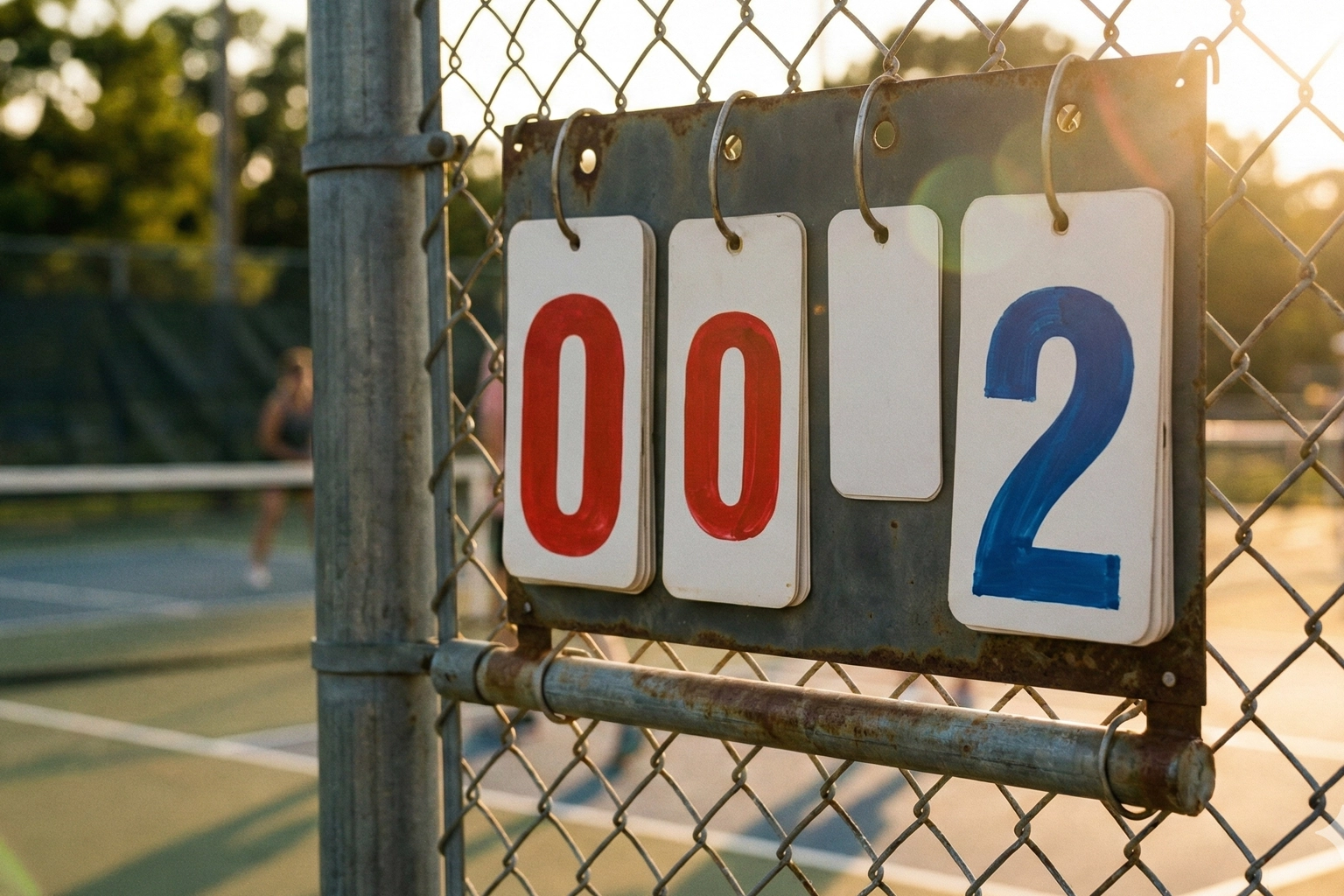
Stop Confusing 0-0-2 With This Simple Trick
Let’s be honest: The hardest part of pickleball isn’t the dink, the drop shot, or staying out of the Kitchen. It’s the math.
If you are a beginner, you have probably stood at the baseline, paddle in hand, sweating not because of the heat, but because everyone is waiting for you to announce three random numbers that sound more like a locker combination than a sports score.
“4-3-2? 3-4-1? Wait, am I 1 or 2?”
It’s the most common source of anxiety for new players. You just want to hit the ball, but first, you have to solve a riddle. If this sounds like you, take a deep breath. You aren’t alone. Every single pro player you see on TV started exactly where you are right now.
The good news? Once it clicks, you will never un-see it.
In this guide, we are going to strip away the confusion. We are going to ignore the complicated rulebook jargon and use a simple mental trick called “Me-You-Who” that will have you shouting the score with confidence in less than five minutes.
[Recommended Reading: Master the basics first with our How to Play Pickleball Guide]
The Basics: How to Win
Before we get into the three-number headache, let’s establish the ground rules of winning.
Pickleball games are typically played to 11 points, and you must win by 2 points. This means a score of 11-10 isn’t a win; you have to keep playing until someone is two points ahead, like 12-10 or 15-13.
But here is the golden rule that trips up tennis players and converts from other sports: You can ONLY score points when your team is serving.
In tennis, if the server double faults, the receiver gets a point. In pickleball? No such luck. If you are receiving the serve and you win the rally, you don’t get a point. You simply win the right to serve (or move the serve to the next person). This makes the game unique because you have to earn your points on the offensive.
So, remember:
- Serve -> Win Rally -> Get Point.
- Receive -> Win Rally -> Get the Ball Back.
Decoding the 3 Numbers (The “Me-You-Who” Trick)
Okay, let’s tackle the scary part. In doubles pickleball, the score is made up of three numbers. It looks like this: [Server Score] – [Receiver Score] – [Server Number]
When you are standing on the baseline preparing to serve, trying to remember that sequence can feel like doing algebra under pressure. So, stop thinking about “Server” and “Receiver.” Instead, use the Me-You-Who trick.
Whenever you are about to serve, say these three things in your head:
- Me: What is My team’s score?
- You: What is Your team’s score?
- Who: Who am I? (Am I Server 1 or Server 2?)
Let’s look at an example. Imagine your team has 5 points. The other team has 3 points. You are the first person on your team to serve in this rotation. Using the Me-You-Who trick:
- Me: 5
- You: 3
- Who: 1
- You shout: “5-3-1!”
Let’s flip it. Maybe you are losing. Your team has 2 points. The opponents have 8. You are the second person serving on your team because your partner just lost their serve.
- Me: 2
- You: 8
- Who: 2
- You shout: “2-8-2!”
See? It’s not a code. It’s just a conversation. “I have 2, You have 8, and I am the 2nd server.”

Understanding Server 1 vs. Server 2
You might be asking, “Why is there a Server 1 and Server 2? Why don’t we just switch turns?”
Pickleball is unique because both partners on a doubles team get a chance to serve before the ball goes over to the other team. We call this a service turn. Think of it like a video game where your team has two “lives.”
The Life of Server 1
When the ball comes to your team (a Side Out), the person standing in the Right (Even) court always serves first. They are Server 1. If Server 1 serves and wins the point, great! They switch sides with their partner and serve again. They keep serving until they lose a rally. When they lose a rally, the team doesn’t lose the ball yet. They just lose “Life #1.”
The Life of Server 2
Now, the ball goes to the partner. They are Server 2. They announce the score (remembering to say “2” at the end). They serve until they lose a rally.
The Side Out
Once Server 2 loses a rally, both “lives” are gone. This is called a Side Out. The ball goes over to the opponents, and they start fresh with their own Server 1.
Summary of the flow:
- Side Out (Ball comes to your team).
- Server 1 serves. (Team keeps serving as long as they win points).
- Server 1 faults/loses rally.
- Server 2 serves. (Team keeps serving as long as they win points).
- Server 2 faults/loses rally.
- Side Out (Ball goes to the other team).
The “0-0-2” Exception (Starting the Game)
There is one major exception to everything I just told you, and it is the source of 90% of beginner confusion.
When the game first starts, the score is 0-0. You would think the first person to serve would call “0-0-1,” right? Wrong. The very first score called in every doubles game is “0-0-2”.
“Wait,” you ask. “Why am I number 2? I’m the first person serving!”
This is the Fairness Rule. In pickleball, the serving team has a statistical advantage because they are the only ones who can score points. If the first team got two servers (two “lives”) right at the start of the game, they might rack up 5 or 6 points before the other team ever touches the ball. That’s a huge head start.
To keep it fair, the rulebook says the first serving team only gets one server. You start the game assuming your partner has already “lost” their serve. You are skipping straight to the second life.
So, the game starts:
- You serve at 0-0-2.
- If you win a point, you switch sides and call 1-0-2.
- If you lose the rally, because you are the “2nd server,” it’s an immediate Side Out. The ball goes to the other team.
- The other team now starts normally. Their first server calls “0-0-1”. They get both servers.
Think of 0-0-2 as a handicap to keep the game exciting. You sacrifice your “Server 1” turn just for the privilege of starting the game.
Positioning: Even/Right, Odd/Left
Now that you know what to say, do you know where to stand? Nothing screams “newbie” louder than standing in the wrong court when calling the score. But don’t worry, the score actually tells you exactly where to be. We call this the Even/Odd Rule.
For the Server: Look at Me (your team’s score).
- Is your score an Even number (0, 2, 4, 6, 8…)? You must serve from the Right service court.
- Is your score an Odd number (1, 3, 5, 7, 9…)? You must serve from the Left service court.
A simple way to remember this is: You start the game at 0 (Even) on the Right. “Even” and “Right” are best friends.
Important Note for Doubles: This rule strictly applies to the First Server when your team gets the ball back (Side Out). Once you start scoring points and switching sides with your partner, things get dynamic. But if you ever forget who should serve first after a Side Out, check your score: Even score? Start from the Right. Odd score? Start from the Left.
Singles Scoring (Briefly)
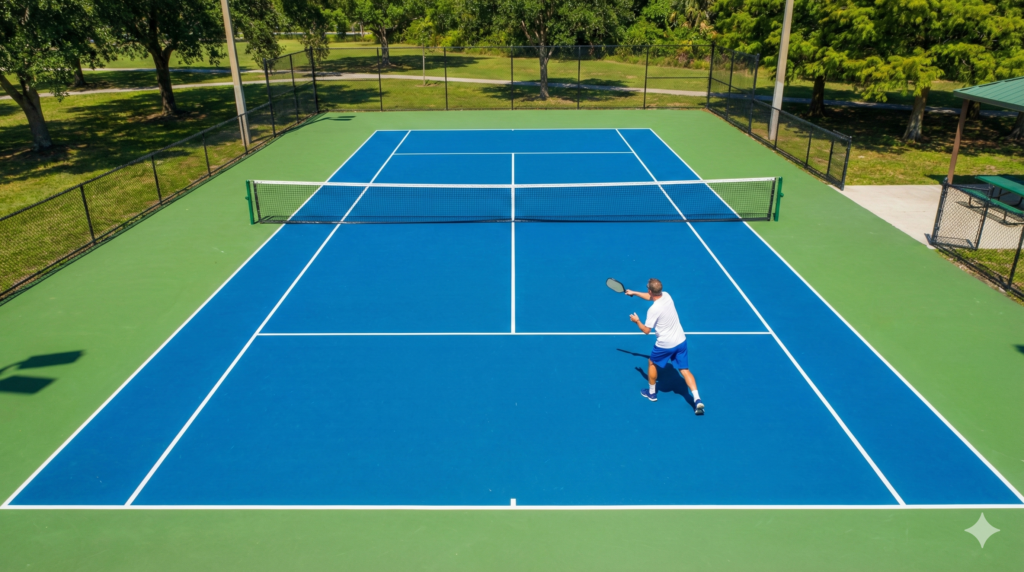
If you decide to brave the court alone for some singles play, the good news is that scoring is much easier. There is no “Server 2” in singles because you don’t have a partner to pass the ball to. In singles, you only call two numbers: [Me] – [You].
Example: “1-0.”
The positioning rule in Singles is absolute:
- If your score is Even, you MUST serve from the Right.
- If your score is Odd, you MUST serve from the Left.
- If you lose the rally, it’s an immediate Side Out. The opponent serves from whichever side their score dictates (Even/Right or Odd/Left). Simple, right?

Conclusion
Does your brain hurt a little less now?
It’s completely normal to mess up the score a few times. I’ve seen players who have been at this for years still shout, “Wait, am I a 1 or a 2?” It happens to the best of us.
The most important thing is to be loud and proud. Don’t whisper the score. If you get it wrong, your opponents (or your partner) will gently correct you. Pickleball is a friendly game—we help each other out.
So, grab your paddle, head to the local courts, and remember the trick: Me-You-Who. And when you step up to start that first game, confidently shout “0-0-2!” and watch everyone nod in approval.
You’re ready to play.