
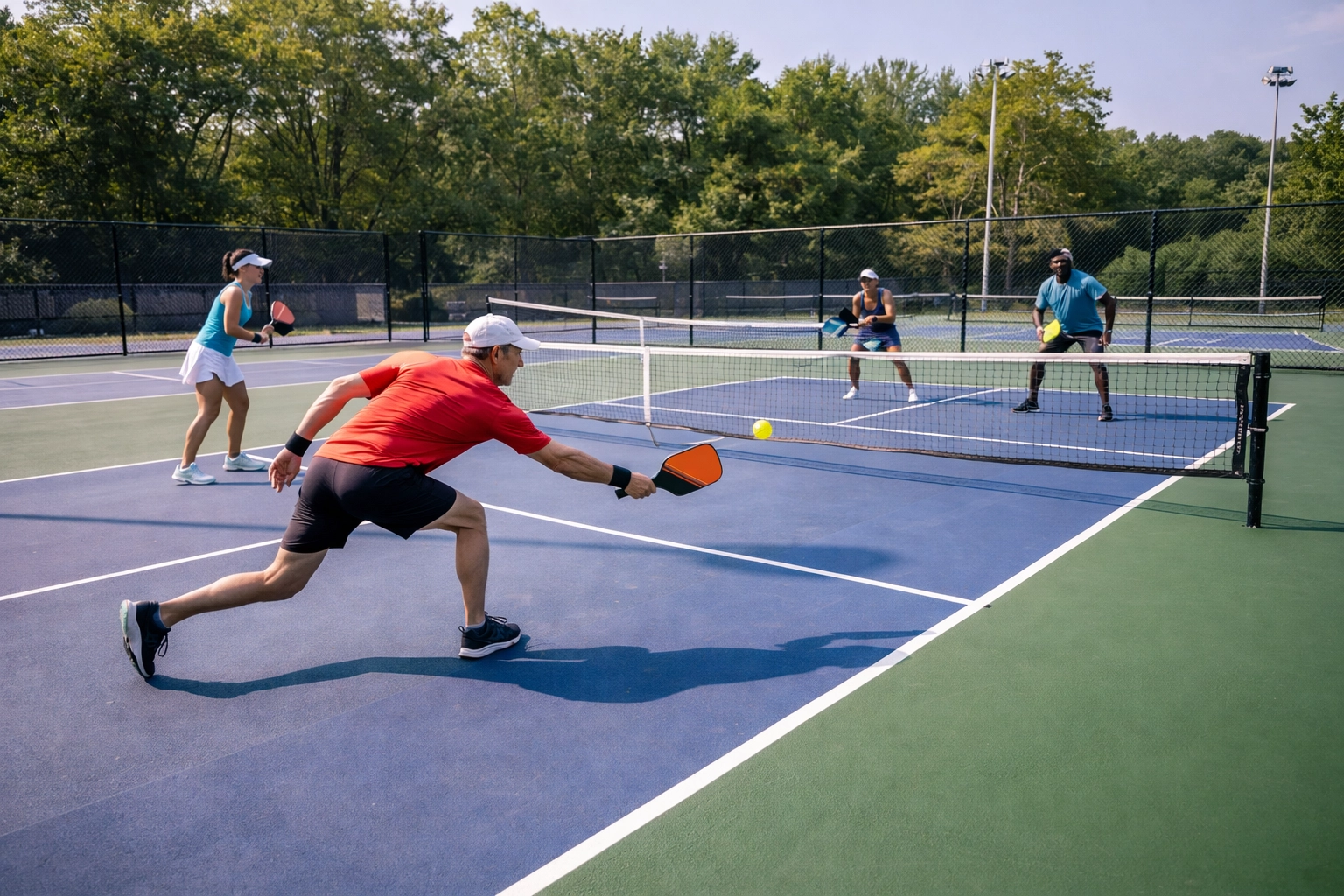
The Ultimate Beginner’s Guide (Rules & Basics)
It seems like overnight, everyone started talking about pickleball. You see the courts popping up in parks, your friends are posting sweaty selfies with paddles, and even your parents might be joining a league. It’s officially the fastest-growing sport in America, and for good reason—it’s social, it’s a great workout, and unlike tennis or golf, you can actually get pretty decent at it in an afternoon.
But let’s be real: watching a game for the first time can be confusing. Why is everyone shouting three numbers before serving? Why can’t they step in that specific colored box near the net? And why is it called “the kitchen”?
If you’ve been hesitant to jump in because you don’t know the rules, you’re in the right place. We’re going to strip away the confusion and break down everything you need to know. By the time you finish reading this, you’ll have the confidence to walk onto a court, hold your own, and understand exactly why everyone is so obsessed with this game.
Table of Contents
What is Pickleball? (The “Explain Like I’m Five” Version)
Think of pickleball as the love child of tennis, badminton, and ping pong.
- Like Tennis: You play on a hard court with a net, and the scoring feels somewhat competitive.
- Like Badminton: The court is smaller (about the same size as a doubles badminton court), meaning less running and more quick-reflex action.
- Like Ping Pong: You use a hard paddle and a plastic ball, and the game relies heavily on hand-eye coordination.
The beauty of pickleball is its accessibility. The court is smaller than a tennis court (20 feet by 44 feet), which means you don’t have to be a marathon runner to cover the ground. The underhand serve is easier to master than the complex overhead smash of tennis, leveling the playing field between beginners and athletes.
Whether you are 25 or 65, pickleball hits that sweet spot of being easy to learn but hard to master, making it addictive from the very first point.
Gear Essentials: What Do You Actually Need?
One of the best things about pickleball is that the barrier to entry is low. You don’t need hundreds of dollars of equipment to start. However, showing up with the wrong gear can make learning harder than it needs to be. Here is your starter pack checklist.
The Paddle: Wood vs. Composite
When you walk into a sporting goods store, you’ll see paddles ranging from $15 to $250.
- Wood Paddles: These are the cheapest options, often found in 2-packs for $20. Honest advice? Avoid them if you can. They are heavy, have zero “pop,” and can actually strain your wrist and elbow because of the weight.
- Composite/Graphite Paddles: This is what you want. You don’t need the pro-level $200 paddle yet, but spending $40–$60 on a decent composite honeycomb core paddle will change your game. They are lighter, offer better control, and sound much better when you hit the ball.
[Recommended Reading: The Best Pickleball Paddles for Beginners in 2026]
The Ball: Indoor vs. Outdoor
Believe it or not, not all plastic balls are created equal. If you bring an indoor ball to an outdoor court, you’re going to have a bad time.
- Outdoor Balls: These usually have 40 smaller holes. They are made of harder plastic to withstand rough court surfaces and wind. Because they are harder, they come off the paddle faster.
- Indoor Balls: These typically have 26 larger holes. The plastic is softer and lighter, designed for gym floors. They drag more in the air and are easier to control, but they will crack quickly if used on concrete.
Court Shoes: Safety First
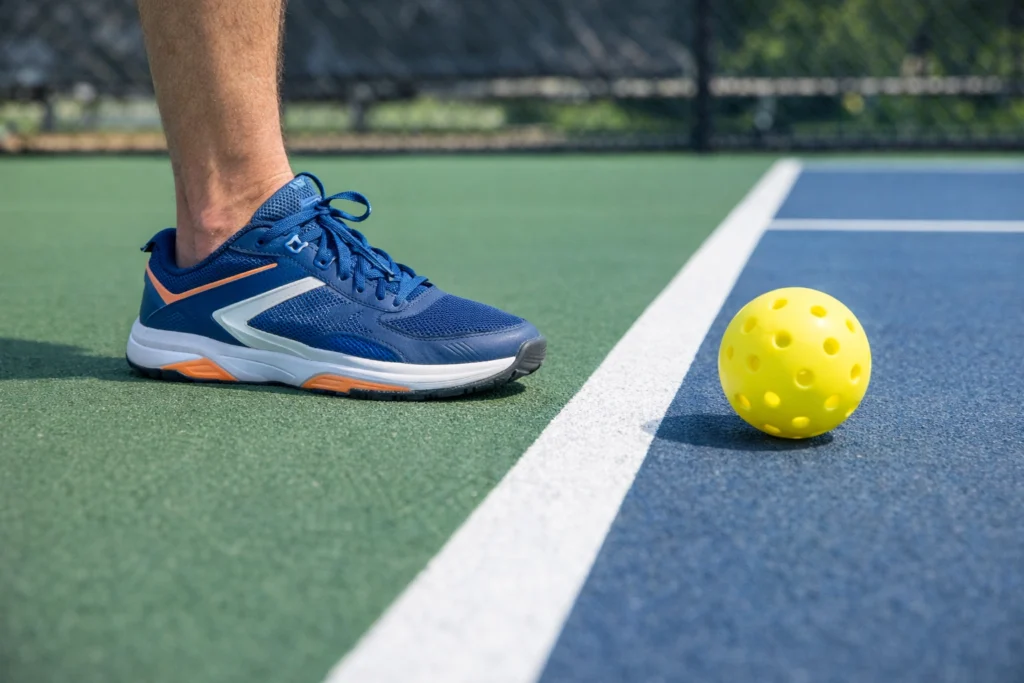
This is the most overlooked piece of gear. Please, do not play pickleball in running shoes. Running shoes are designed for forward motion. Pickleball requires sudden lateral (side-to-side) stops and starts. Wearing running shoes with high foam heels is a recipe for a rolled ankle.
Look for “court shoes” (tennis or volleyball shoes) that have a flat, durable sole and good lateral support. Your ankles will thank you.
[Recommended Reading: Best Pickleball Shoes for Wide Feet & Comfort]
The Court Layout Explained
Before we get into the rules, let’s look at the battlefield. A standard pickleball court is a rectangle, 20 feet wide by 44 feet long. The net sits at 36 inches high on the sides and dips to 34 inches in the center.
But the most important part of the court—the part that confuses beginners the most—is the Non-Volley Zone, affectionately known as The Kitchen.
This is the 7-foot area extending from the net on both sides. It’s usually marked by a line or a different court color. We will explain the specific rules for this zone in a moment, but for now, just know this: it’s the “no-fly zone” for volleys.
The 5 Golden Rules of Pickleball
You don’t need to memorize a 50-page rulebook to play a fun game. You just need to master these five golden rules.
Rule 1: The Serve
In tennis, you toss the ball high and smash it down. In pickleball, we keep it friendly.
- Underhand Only: The serve must be hit with an underhand stroke. Contact with the ball must happen below your waist (specifically, the navel).
- The Diagonal: You must serve diagonally to the opponent’s service box.
- Feet Placement: Keep at least one foot behind the baseline when you strike the ball.
- No “Let” Serves: If the ball hits the net and still lands in the correct service box, play continues! There are no “do-overs” in pickleball serves anymore. It’s a live ball.
Rule 2: The Two-Bounce Rule
This is the rule that trips up tennis players the most. It prevents the serving team from rushing the net and smashing the ball immediately. Here is how it works:
- Bounce 1: The server hits the ball. The receiver must let it bounce before returning it.
- Bounce 2: The serving team must let the return bounce before hitting it.
After those two bounces (one on each side), the gloves are off. You can volley the ball (hit it out of the air) or play it off the bounce. If you try to volley the ball before that second bounce occurs, you lose the point.
Rule 3: No Volleys in the Kitchen
The Kitchen rules prevent players from standing right on top of the net and smashing everything down.
- You cannot volley the ball while standing in the Kitchen or touching the Kitchen line.
- It goes even further: if your momentum carries you into the Kitchen after you hit a volley, it’s a fault. You lose the point.
- Exception: You can step into the Kitchen to hit a ball that has already bounced. This is why you’ll see players gently “dinking” the ball over the net—they are waiting for a ball to bounce so they can step in.
Rule 4: Line Calls
Pickleball is a game of honor. In most recreational games, you make the calls on your side of the net.
- Lines are IN: If the ball hits the sideline or baseline, it is considered “in.”
- Kitchen Line Exception: On the serve, if the ball hits the Kitchen line, it is “out” (a fault). During the rally, the Kitchen line is part of the Kitchen.
- If you aren’t 100% sure the ball was out, the etiquette is to call it “in.” Benefit of the doubt always goes to the opponent.
Rule 5: Faults
A “fault” is any action that stops play because of a rule violation. When you commit a fault, you lose the rally. Common faults include:
- Hitting the ball out of bounds.
- Hitting the ball into the net.
- Volleying from the Kitchen.
- Volleying before the ball has bounced once on each side (Two-Bounce Rule).
How Scoring Works (Simplified)
Okay, take a deep breath. Scoring is usually the hardest part for beginners to grasp, but once you play a few points, it clicks.
The Basics
- Points: Games are typically played to 11 points, and you must win by 2 points.
- Serving Team Only: You can only score points when your team is serving. If you win a rally while receiving, you don’t get a point—you just win the right to serve (this is called a “side-out”).
The 3-Number Score
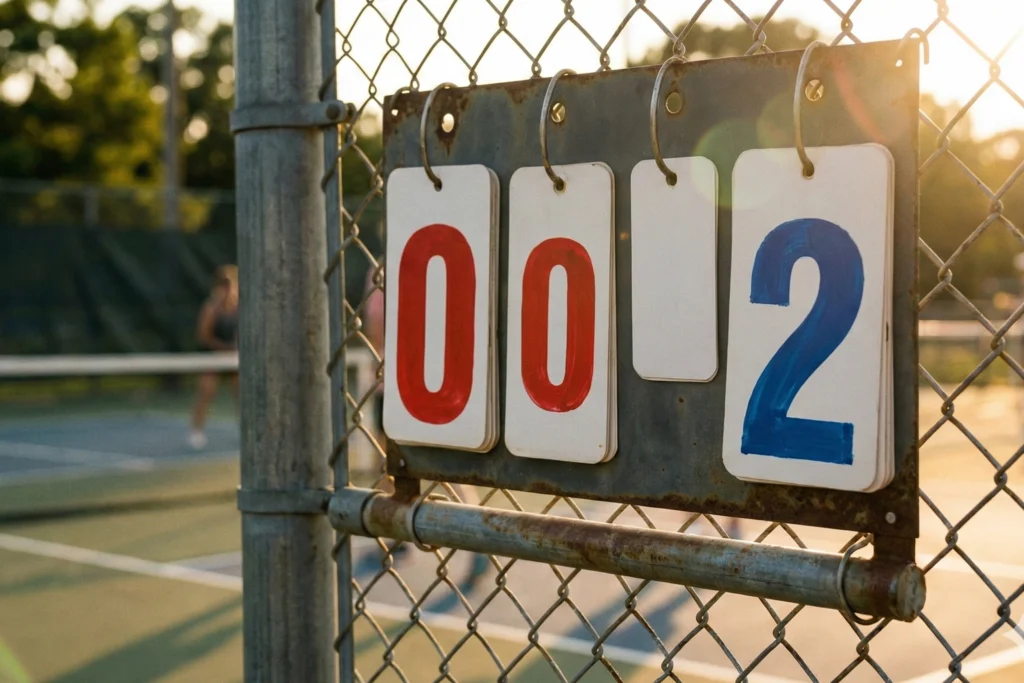
In doubles (which is the most common way to play), you call out three numbers before every serve. Example: “4 – 2 – 1”
- First Number (4): The serving team’s score.
- Second Number (2): The receiving team’s score.
- Third Number (1): The server number (either 1 or 2).
Server 1 and Server 2
In doubles, each player on a team gets a chance to serve before the ball goes to the other team (a side-out).
- Player 1: The person on the right side starts serving. They continue serving as long as they win points, switching sides (left/right) with their partner after each point.
- Player 2: Once the team loses a rally, the serve doesn’t go to the opponents yet. It goes to the partner (Server 2).
- Side Out: Once Server 2 loses a rally, the serve goes over to the other team.
The Exception: At the very start of the game, only one person on the first team gets to serve. The score starts at 0-0-2 (or “Start”). This rule exists to minimize the advantage of the team that serves first, keeping the game fair.
Singles vs. Doubles: Key Differences
While 90% of pickleball is played as doubles, singles is a fantastic workout if you’re up for the cardio challenge. The rules are largely the same, but the strategy shifts.
- No “Server 2”: In singles, there is no partner to hand the ball to. If you lose the rally, the serve goes immediately to your opponent.
- Positioning: In singles, you serve from the right side when your score is even (0, 2, 4) and from the left side when your score is odd (1, 3, 5).
- Strategy: In doubles, the goal is to get to the net (Kitchen line) as fast as possible. In singles, you often have to play from the baseline more often to cover the open angles.
Your First Game Awaits
There you have it—you are officially ready to hit the courts.
Don’t worry about being perfect. You will likely step in the Kitchen when you shouldn’t. You might forget the score. You will almost certainly volley the ball before the second bounce at least once. It happens to everyone!
The community is incredibly welcoming, and seasoned players are usually happy to help you with scoring or positioning during open play.
The most important thing? Just get out there. Grab a paddle, find a local court, and see why millions of people have fallen in love with this quirky, fast-paced game.