
The 3 Best Portable Pickleball Nets in 2026: Stop Playing on Saggy Courts
Introduction There is nothing more frustrating than trying to practice your third-shot drops over a net that sags three inches in the middle.
Most beginners buy the cheapest portable pickleball net they can find. Two weeks later, the metal poles rust, the wind blows the entire frame over, and the top tape droops so low that the net becomes completely useless for serious practice. If your net isn’t perfectly tensioned at 34 inches in the center, you are actively ruining your muscle memory.
Whether you want to set up a quick game in your driveway or you need a true tournament-grade practice court, you need equipment that actually works. We analyzed tension systems, frame weight, and weather resistance to find the only three portable pickleball nets worth your money in 2026.
(Before you set up your court, make sure you are using the right ball for the surface. Check out our guide to the [Best Outdoor Pickleball Balls in 2026]).
The Quick Comparison: Top 3 Portable Nets
Stop Playing on Saggy Courts: The 3 Best Portable Pickleball Nets (2026)
Don't waste money on cheap nets that sag in the middle and blow over in the wind. Whether you need a small driveway setup or a 22-foot carbon fiber regulation court, these are the only nets worth buying.
Detailed Reviews: The Top 3 Portable Pickleball Nets
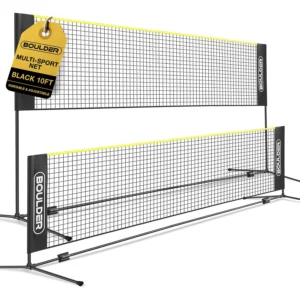
1. Boulder Portable Net Set: Best for Driveways and Kids
Let’s get one thing straight immediately: this is not a 22-foot regulation-size net. But for most families, that is exactly why it is the best choice.
What Makes It Stand Out: If you want to play a casual game in your backyard or driveway, a massive 22-foot tournament net simply won’t fit. The Boulder net comes in smaller sizes (10ft, 14ft, 17ft) making it the absolute best “grab-and-go” option.
It is incredibly lightweight and features a bungee-corded pole system (like a camping tent). You can set it up in less than 3 minutes without any tools. You can also adjust the height, allowing you to use it for kids’ tennis or badminton when you aren’t playing pickleball.
- Pros: Fits in narrow driveways, extremely lightweight, sets up in 3 minutes, highly affordable.
- Cons: Not regulation width or height, frame is too light to withstand heavy winds.
- Bottom Line: If you want a fun, affordable net for the kids to use in the driveway, buy the Boulder. If you are training for a tournament, skip this and look below. [Check Current Price on Amazon]
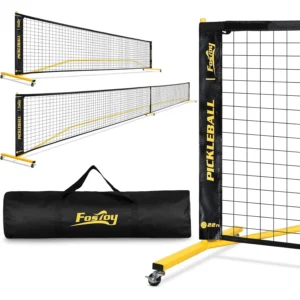
2. Fostoy Pickleball Net: Best Budget Regulation Net
If you want a true, 22-foot regulation-size court in your cul-de-sac without spending $300, the Fostoy portable net is the smartest budget investment.
What Makes It Stand Out: The biggest issue with 22-foot portable nets is the “sagging middle.” Gravity pulls the heavy net down, ruining the 34-inch center height requirement. Fostoy solves this by including a fiberglass center support pole that pushes the middle of the net up, keeping the top tape perfectly taut.
The frame is made of interlocking steel tubes with a powder-coated finish to resist rust. It weighs around 20 lbs, making it heavy enough to survive a breezy afternoon but light enough to pack into the included carrying bag. (If you are building your home court on a tight budget, pair this net with one of our top picks for the [Best Pickleball Paddles Under $100]).
- Pros: True 22-foot regulation size, center support pole prevents sagging, interlocking metal frame requires no tools, very affordable.
- Cons: Steel will eventually rust if left outside in the rain permanently. The net tape can fray over time with heavy use.
- Bottom Line: The Fostoy delivers a true tournament-sized court experience at a fraction of the cost. It is the best entry-level regulation net on the market. [Check Current Price on Amazon]
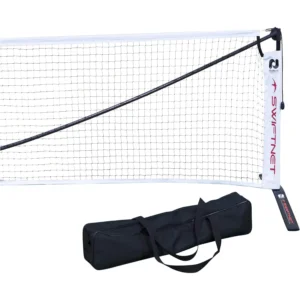
3. SwiftNet Portable Pickleball Net: Best Premium / Tournament Net
This is the holy grail of portable nets. If you are a serious player, a coach, or simply someone who refuses to buy cheap gear that breaks, the SwiftNet is a masterpiece of engineering.
What Makes It Stand Out: Traditional nets rely on heavy steel and gravity to hold the net up. SwiftNet uses aerospace-grade carbon fiber and recycled aluminum. The entire 22-foot regulation system weighs only 14 pounds. It will never, ever rust.
But the real magic is the tension system. It uses a shock-corded locking mechanism that pulls the top tape so tight that the ball will actually bounce off the top cord just like a permanent, professionally installed court net. There is zero sag. It sets up in two and a half minutes and stands up to heavy winds without blowing over. (Warning: Practicing on hard concrete driveways destroys your knees. Protect your joints with the [Best Pickleball Shoes for Wide Feet]).
- Pros: Carbon fiber frame never rusts, true tension system completely eliminates sagging, ultra-lightweight (14 lbs), built to last a lifetime.
- Cons: Premium price tag.
- Bottom Line: Buy it once, and never buy a net again. The SwiftNet is the only portable net that actually feels like playing on a permanent professional court. [Check Current Price on Amazon]
Buying Guide: What to Look For in a Portable Net
Regulation Size vs. Driveway Size A true USA Pickleball regulation net is 22 feet wide, 36 inches high at the sidelines, and 34 inches high in the exact center. If you are practicing for a league, you must buy a 22-foot net (like the Fostoy or SwiftNet). If you just want to dink around with your family in a narrow space, a 10ft or 14ft net (like the Boulder) is much more practical.
The Center Support Pole (Non-Negotiable) A 22-foot net is heavy. Without support, the middle of the net will sag down to 30 inches, ruining your practice drops. Any regulation net you buy MUST have a vertical center support pole (or a high-tension carbon fiber system like the SwiftNet) to maintain that strict 34-inch center height.
Weather Resistance Do not leave your portable net outside in the rain. Even “powder-coated” steel frames will eventually rust at the joints where the metal grinds together. If you plan to leave your net permanently assembled in your backyard, you must invest in the carbon fiber SwiftNet, as carbon fiber and aluminum are impervious to rust.
Frequently Asked Questions
Can I leave my portable pickleball net outside? Unless you own a carbon fiber net (like the SwiftNet), the answer is no. Standard steel frames will rust, and UV rays from the sun will dry rot the nylon netting. Always break your net down or roll it into a garage after playing.
How long does it take to set up a portable net? Most modern nets use a bungee-corded or push-button interlocking tube system. Once you understand the sequence, one person can set up a 22-foot net in 3 to 5 minutes without any tools.
Why does my net blow over in the wind? Because the wind catches the mesh netting like a sail. If you live in a windy area, buy a net with wide base legs, or simply place a 10-pound sandbag over the center base bar to keep it anchored.
Conclusion
Practicing on a cheap, sagging net is worse than not practicing at all because it builds terrible muscle memory.
If you just need a small, fun net for the kids, grab the Boulder. If you want a regulation 22-foot court on a budget, the Fostoy is your best bet. But if you want professional-level tension, zero sagging, and a carbon fiber frame that never rusts, the SwiftNet is the ultimate investment.
Turn your driveway into a real court today, and start drilling.